We use strictly necessary cookies to run AaharIQ, and optional functional/analytics cookies to improve it. You can accept all, reject non-essential ones, or . See our Cookie Policy for details.

India Spent ₹2.8 Lakh Crore on Ultra-Processed Food in 2023

Ultra-processed food in India is linked to diabetes, heart disease, obesity & cancer. Know the NOVA classification, FSSAI data & which Indian products to avoid in 2026.
Every time you tear open a packet of instant noodles, crack a can of cola, or reach for a bright-yellow cheese-flavoured snack, you are eating ultra-processed food. India consumed ₹2.8 lakh crore worth of it in 2023 — and the number is rising by over 13% every year.
The science is now unambiguous: ultra-processed foods (UPFs) are directly linked to diabetes, heart disease, obesity, and certain cancers. India is experiencing all four at epidemic scale. Understanding what ultra-processed food is, how to spot it, and how to protect yourself is no longer optional — it is essential.
What Is Ultra-Processed Food? (The NOVA Classification Explained)
The NOVA system, developed by researchers at the University of São Paulo, classifies all food into four groups based on the extent of industrial processing:
NOVA Group 1 — Unprocessed or minimally processed foods Fresh fruit, vegetables, eggs, plain milk, dried pulses, unseasoned rice, plain meat. These are your aahar foundation.
NOVA Group 2 — Processed culinary ingredients Salt, sugar, oil, flour, butter. Ingredients used to cook, not eaten alone.
NOVA Group 3 — Processed foods Cheese, canned fish, smoked meats, fresh bread. Simple combinations of Group 1 and 2 with recognisable ingredients.
NOVA Group 4 — Ultra-processed foods Industrial formulations with five or more ingredients, most of which you would never find in a home kitchen: emulsifiers, stabilisers, artificial colours, flavour enhancers, preservatives, hydrogenated oils, high-fructose corn syrup, and protein isolates.
If you cannot pronounce the ingredient or would not find it in your kitchen, you are almost certainly eating NOVA Group 4.
Ultra-Processed Food in India: The Scale of the Problem
Market Growth
India's ultra-processed food sector grew at a compound annual growth rate (CAGR) of 13.37% between 2011 and 2021. Retail sales surged from USD 0.9 billion in 2006 to approximately USD 38 billion in 2019. India now has one of the fastest-growing UPF markets in the world.
What Indians Are Actually Eating
Walk through any Indian grocery store and ultra-processed foods dominate the shelves:
The Health Consequences: What Research Says
1. Diabetes
India has the second-highest number of people with diabetes in the world. The ICMR-INDIAB national study (2023) found 101 million Indians have diabetes and 136 million have prediabetes. A primary dietary driver is the shift toward ultra-processed, high-glycaemic foods.
Research published in Public Health Nutrition found that increased UPF intake in Indian adults was significantly associated with nutritional inadequacy and higher risk of chronic disease. The refined carbohydrates dominant in UPFs cause rapid blood sugar spikes, driving insulin resistance over time.
2. Heart Disease
Cardiovascular disease accounts for 28% of all deaths in India — the leading cause of mortality. Ultra-processed foods contribute through three mechanisms:
Excessive sodium — The average Indian consumes 11 grams of salt per day, more than double the WHO-recommended 5 grams. Most of this excess comes from packaged food.
Trans fats and hydrogenated oils — Still present in many Indian snack products.
High sugar — Linked to triglyceride elevation, a direct cardiac risk factor.
A large meta-analysis found that consuming ultra-processed foods was associated with a 67% higher risk of cardiovascular disease.
3. Obesity
The ICMR-INDIAB study found 28.6% of Indians have generalised obesity and 39.5% have abdominal obesity — the numbers have doubled in a decade. Ultra-processed foods are engineered to be hyperpalatable (you cannot eat just one), calorie-dense, and nutrient-poor. Their high sugar, fat, and salt content overrides the body's natural satiety signals.
4. Cancer
The International Agency for Research on Cancer (IARC) classifies processed meat as a Group 1 carcinogen — the same category as tobacco. Each 50-gram daily serving of processed meat increases colorectal cancer risk by 18%. Several preservatives and additives in UPFs (including BHA, sodium nitrite, and artificial colours) are classified as possible or probable carcinogens.
The Additive Problem: What's Actually in Your Packet
One of the defining features of ultra-processed foods is the length of their ingredient list — and the proportion of that list occupied by substances that serve no nutritional purpose but an industrial one. Consider a typical Indian instant noodle: wheat flour, refined palm oil, salt, sugar, thickeners (INS 407, 412), flavour enhancers (INS 621 — MSG, INS 627, INS 631), acidity regulators (INS 330), and artificial flavouring and colouring. INS 621 (MSG) is generally recognised as safe in moderate amounts but is specifically added to increase palatability and consumption. INS 407 is carrageenan, a thickener that has raised some concern in animal studies about gut inflammation, though human evidence remains inconclusive.
The concern isn't usually any single additive in isolation — it's cumulative exposure from eating multiple UPFs every day, over years. A child eating Maggi for lunch, chips as an after-school snack, a packaged juice, flavoured biscuits for evening tea, and a ready-to-eat curry pouch for dinner consumes dozens of additives daily that have never been tested in combination at those levels. FSSAI permits these additives individually within approved limits, but — like every food regulator globally — does not require safety testing of the combined additive load from realistic multi-product daily consumption patterns.
The NOVA UPF Screener for India, validated in the British Journal of Nutrition in 2025, found the most commonly consumed UPFs in Indian adult diets were packaged biscuits, salted snacks, packaged bread, flavoured beverages, and instant noodles — closely mirroring the UPF distribution already seen in higher-income countries, suggesting India's UPF transition is following the same pattern, compressed into a much shorter time window.
Children Are the Most Vulnerable — And the Most Targeted
UPF marketing in India is specifically and heavily concentrated on children — cartoon character packaging, celebrity endorsements, IPL advertising slots, and social media influencer campaigns. Documented tactics include advergames, school sponsorship deals, and advertising on children's YouTube channels for instant noodles, chips, flavoured milk drinks, and breakfast cereals. The Breastfeeding Promotion Network of India (BPNI) has specifically flagged UPF marketing aimed at Indian children as a public health concern, citing evidence that early exposure to hyper-palatable UPFs shapes taste preferences and food choices for life.
The nutrition profile of products most heavily marketed to Indian children is revealing: breakfast cereals marketed as "health foods" for children routinely contain 20-30% added sugar by weight. Flavoured milk drinks sold on claims of "growth" and "strength" carry significant refined sugar and malt extract alongside the milk. Flavoured biscuits positioned as "energy" foods are, by NOVA classification, ultra-processed industrial products. The FOPL (front-of-pack labelling) regulation, when finalised, would require high-sugar warning labels on many of these — which may explain the sustained industry lobbying that has delayed its implementation.
Traditional Indian Foods vs. UPFs: The Real Comparison
One of the most useful reframes here is comparing traditional Indian foods against their ultra-processed equivalents. A home-made roti from whole wheat atta, cooked on a tawa with a little ghee, is NOVA Group 1-2. A "multigrain" packaged bread sold with a health halo contains refined wheat flour, soy flour, modified starch, iodised salt, partially hydrogenated vegetable shortening, emulsifiers, and preservatives — NOVA Group 4. A home-made dal tadka is NOVA Group 1-2. A packaged "dal makhani, ready in 3 minutes" pouch contains hydrogenated vegetable fat, modified starch, anti-caking agents, and artificial flavouring — NOVA Group 4.
The useful conclusion here: India's traditional food culture — dal-chawal, sabzi-roti, idli-sambar, poha, upma — is, by the NOVA framework, among the most nutritious food traditions in the world. The public health risk comes from UPFs displacing these traditional foods, not from the two coexisting. A household eating home-cooked traditional food six days a week with Maggi as an occasional convenience meal isn't the concern. A household — increasingly common in urban India — where packaged cereals, biscuits, instant noodles, and ready-to-heat pouches make up the majority of daily caloric intake is a different story.
How to Identify Ultra-Processed Food on Indian Labels
When reading a packaged food label in India, look for these red flags:
Ingredient red flags (immediate concern):
Nutrition red flags (per 100g):
The 5-ingredient rule: If a product has more than 5 ingredients and most are chemical names you do not recognise, it is almost certainly ultra-processed.
FSSAI's Response — And Why It Is Not Enough
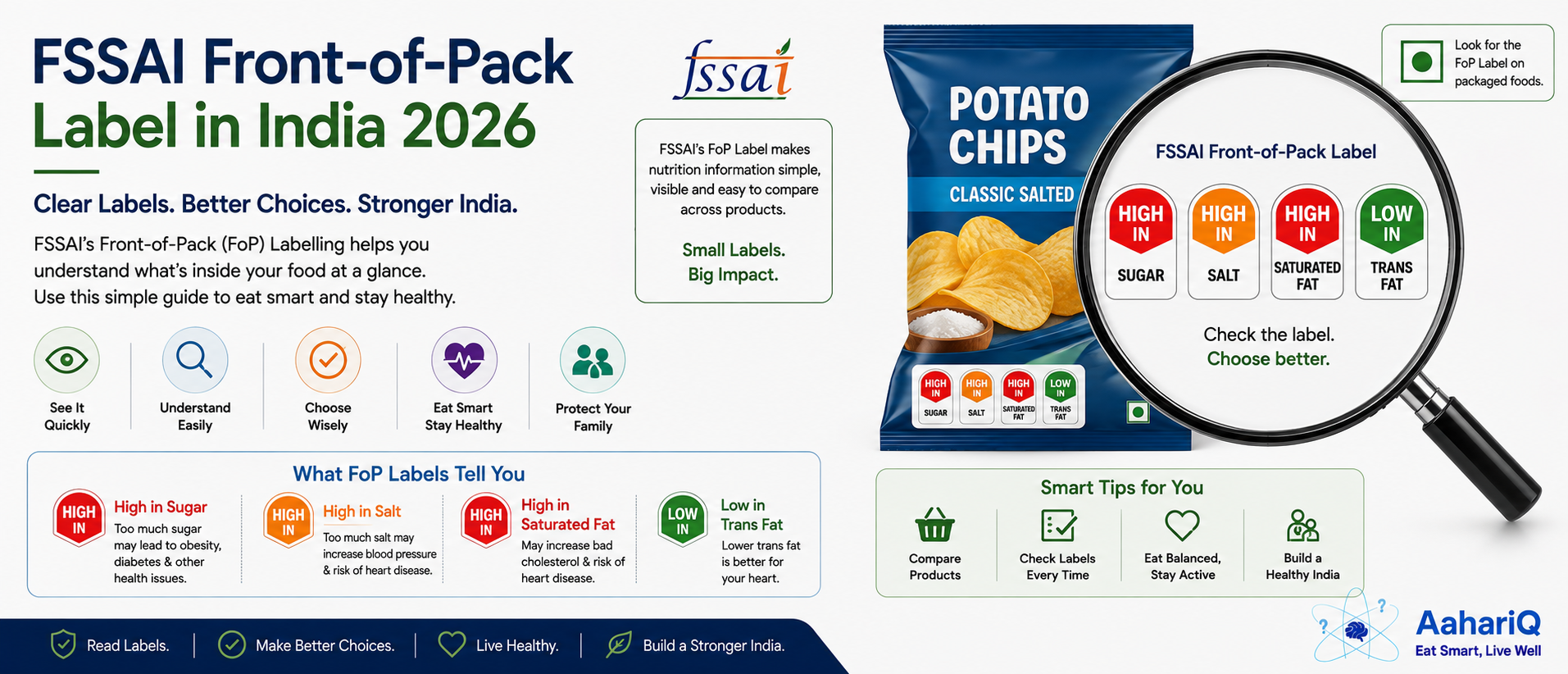
The Food Safety and Standards Authority of India (FSSAI) has been working since 2022 on front-of-pack nutrition labelling (FOPL). In July 2024, the Supreme Court directed FSSAI to implement warning labels on packaged food. The 2024 ICMR dietary guidelines also explicitly recommend minimising processed and ultra-processed food intake.
However, enforcement remains weak. Many Indian UPFs still carry misleading claims like "no added preservatives", "natural flavours", "fortified with vitamins" — all technically true but designed to obscure the product's ultra-processed nature.
This is precisely why an AI-powered food scanner is more useful than reading a government circular.
How AaharIQ Helps You Avoid Ultra-Processed Food
AaharIQ's AI engine classifies every scanned product using the NOVA framework. When you scan a barcode, the app instantly:
Thousands of Indians are already using AaharIQ to make smarter aahar choices. You should too — it takes 3 seconds per product.
Specific product categories deserve their own scrutiny too — see our deep dive on whether protein bars and fitness snacks marketed as "healthy" actually qualify as ultra-processed food.
FAQs: Ultra-Processed Food India
What is the most common ultra-processed food in India?
Instant noodles (Maggi, Yippee), packaged chips (Lays, Kurkure), carbonated drinks (Pepsi, Coke), and packaged biscuits (Parle-G, Bourbon) are the most widely consumed ultra-processed foods in India by volume.
Is Maggi an ultra-processed food?
Yes. Maggi noodles are NOVA Group 4 — ultra-processed. The primary ingredient is maida (refined wheat flour), and the tastemaker sachet contains artificial flavour enhancers (MSG), excess sodium, and preservatives. AaharIQ classifies Maggi as ultra-processed and AVOID for regular consumption.
Are all packaged foods ultra-processed?
No. Some packaged foods — like plain oats, canned chickpeas, or plain yogurt — are minimally processed (NOVA Group 1 or 3). The NOVA classification helps distinguish between them. AaharIQ shows the NOVA group for every scanned product.
What does FSSAI say about ultra-processed food?
FSSAI's 2024 guidelines recommend limiting ultra-processed food intake. FSSAI is developing front-of-pack warning labels that will be mandatory, but as of 2026, these are not yet uniformly enforced on all products.
Can ultra-processed food cause cancer in India?
Certain ingredients in ultra-processed foods — including sodium nitrite (in processed meats), BHA (E320), and artificial colours — are classified as possible or probable carcinogens by the WHO/IARC. Long-term, regular consumption of processed meat increases colorectal cancer risk by 18% per 50g daily serving.
Frequently Asked Questions
Ultra-processed foods are NOVA Group 4 industrial formulations with 5+ ingredients rarely found in home cooking — instant noodles, packaged chips, flavoured drinks, and commercial biscuits. India's UPF market grew 13.37% annually between 2011–2021.
Without AaharIQ — you're scanning labels with your naked eye, missing hidden additives, E-numbers, and FSSAI violations that could silently harm your health over time.
🔍 Scan your food to check for ultra processed food india health instantly
India's free AI food scanner. Detect harmful additives, FSSAI violations & allergens in any packaged food. Get a BUY or AVOID verdict in seconds.
Free tools related to this article
Author
Tags
Related Articles
 ◆
◆Artificial Sweeteners and Health: A Deep Dive with AI Analysis
 ✦
✦The Inflammation-Diet Connection: Ingredients That Drive Silent Disease
 ⬡
⬡How AI Is Transforming Food Safety for People with Chronic Conditions
 📋
📋