We use strictly necessary cookies to run AaharIQ, and optional functional/analytics cookies to improve it. You can accept all, reject non-essential ones, or . See our Cookie Policy for details.

Packaged Bread in India: The Complete Safety Guide
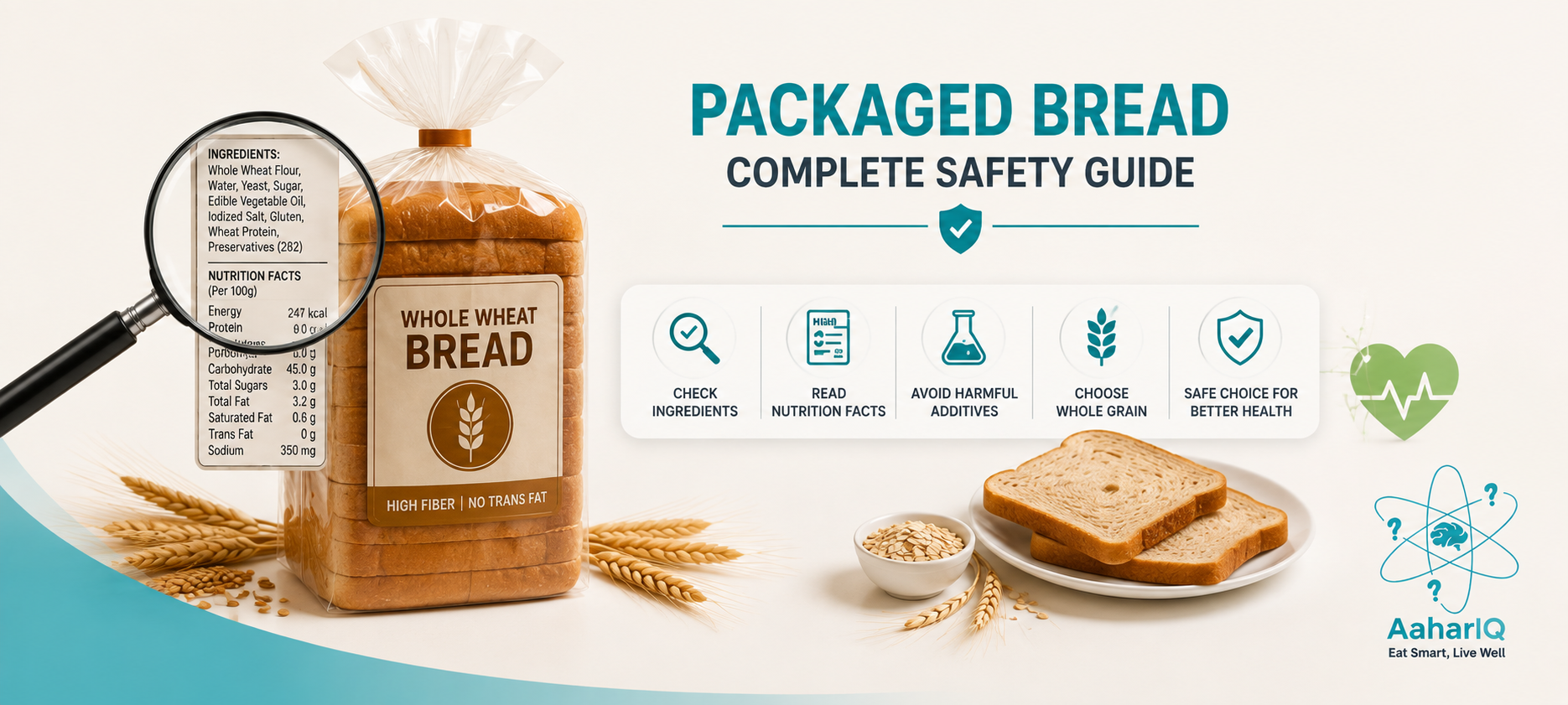
Indians buy 30 lakh bread loaves daily. From potassium bromate to DATEM and azodicarbonamide — here's what's actually in your daily bread.
India's Packaged Bread Market: Scale and Quality Overview
India's packaged bread market is dominated by a relatively small number of major brands with national distribution — Britannia, Harvest Gold (part of Modern), English Oven (ITC), Bonn, and local regional brands. The market produces an estimated 10–15 lakh (1–1.5 million) MT of packaged bread annually, making it one of India's largest packaged food categories by volume. White bread (made from refined wheat flour, maida) dominates, with whole wheat, multigrain, and fortified variants growing as urban consumers become more nutrition-conscious.
Most Indians buy packaged bread frequently — for breakfast toast, school sandwiches, office lunches, and quick evening snacks. Yet bread is one of the most additive-laden food products in the Indian packaged food market. A standard loaf of Indian commercial white bread can contain up to 12–15 distinct ingredients beyond flour and yeast — including emulsifiers, dough conditioners, preservatives, antioxidants, and flour treatment agents. Understanding what each of these does and whether it is safe is the purpose of this guide.
Potassium Bromate: Banned in India Since 2016, Still Found in Tests
Potassium bromate (INS 924) was used extensively as a bread improver — it strengthens gluten development during baking, producing a higher-volume, more uniform loaf. It is classified as a possible human carcinogen (Group 2B) by IARC. Most bromate breaks down during baking, but residues remain in finished bread if baking conditions are suboptimal. The EU banned potassium bromate in bread in 1990. Canada banned it in 1994. The US FDA has been urging bakers to voluntarily discontinue its use since 1999 (though it is technically still permitted).
FSSAI banned potassium bromate as a flour treatment agent in India in 2016 (Food Safety and Standards Regulations, 2016 amendment). However, FSSAI enforcement surveys since the ban have repeatedly found potassium bromate residues in packaged bread samples, particularly from smaller regional bakery brands. A 2023 FSSAI surveillance report found that approximately 8–12% of bread samples from small local bakeries tested positive for potassium bromate residues, indicating ongoing use despite the 2016 ban.
Major national brands (Britannia, Harvest Gold, English Oven) have largely switched to alternative bread improvers (ascorbic acid, amylases, xylanases) following the FSSAI ban. The risk of potassium bromate is higher in locally-produced bakery bread and regional packaged brands without the quality infrastructure of national players. AaharIQ recommends checking the ingredient list — potassium bromate (INS 924) must be declared if used. Products from FSSAI-licensed major brands that do not list INS 924 are using alternative improvers.
Bread Additives Found on Indian Labels: What They Are and Safety Status
DATEM (Diacetyl Tartaric Acid Esters of Mono- and Diglycerides, INS 472e): An emulsifier that strengthens gluten network and extends bread softness. FSSAI-permitted. EFSA has assessed DATEM as safe at current use levels. Not a primary health concern. SSL (Sodium Stearoyl Lactylate, INS 481): Another emulsifier used for softness and crumb improvement. FSSAI-permitted. Generally considered safe by regulatory bodies. Calcium propionate (INS 282): The most common bread preservative in India, inhibiting mould growth. FSSAI-permitted. JECFA has an ADI of 0–10 mg/kg body weight. A 2012 study in rats suggested behavioural effects at high doses, causing parental concern; at dietary exposure levels in humans (well within ADI), no similar effects have been confirmed. Considered safe at typical use. Ascorbic acid (INS 300 — Vitamin C): Used as a dough conditioner and antioxidant to improve bread structure and protect freshness. No safety concerns — Vitamin C is a known nutrient. Azodicarbonamide (ADA, INS 927a): A dough conditioner/bleaching agent used in some Indian bread. The EU has banned ADA as a flour treatment agent since 2005. Subway in the US removed it from bread after a 2014 consumer campaign ('yoga mat chemical'). FSSAI permits ADA in bread flour at up to 45mg/kg. WHO has confirmed ADA itself breaks down rapidly during baking — the concern is its breakdown product semicarbazide, a possible carcinogen, found in bread at trace levels. Emulsifiers broadly (mono and diglycerides, INS 471): Widely used in Indian bread for softness and extended shelf life. Considered safe at current use levels by EFSA and JECFA. Derived from fat (often palm oil-derived). NOVA Group 4 marker.
AaharIQ's summary of the common bread additives discussed above:
| Additive (INS) | Purpose | Safety Status |
|---|---|---|
| DATEM (INS 472e) | Emulsifier - strengthens gluten network, extends softness | EFSA-assessed as safe at current use levels |
| SSL - Sodium Stearoyl Lactylate (INS 481) | Emulsifier - softness and crumb improvement | Generally considered safe by regulatory bodies |
| Calcium propionate (INS 282) | Preservative - inhibits mould growth | JECFA ADI of 0-10 mg/kg body weight; considered safe at typical use |
| Ascorbic acid / Vitamin C (INS 300) | Dough conditioner and antioxidant | No safety concerns - a known nutrient |
| Azodicarbonamide / ADA (INS 927a) | Dough conditioner / bleaching agent | Banned in the EU since 2005; FSSAI permits up to 45mg/kg |
| Mono- and diglycerides (INS 471) | Emulsifier for softness and shelf life | Considered safe by EFSA and JECFA; a NOVA Group 4 marker |
Whole Wheat vs White vs Multigrain Bread in India: Nutrition Comparison
Indian packaged bread labels can be confusing with 'brown bread', 'wheat bread', 'whole grain', and 'multigrain' claims that do not always mean what consumers think:
True Whole Wheat Bread: First ingredient should be 'Whole Wheat Flour (Atta)' — not 'Refined Wheat Flour (Maida)' with added bran. A genuinely whole wheat bread should contain >3g fibre per slice and have a GI of approximately 70 vs ~75 for white bread. Some brands sell 'brown bread' that is simply white bread with added caramel colouring for the brown appearance — not genuinely whole grain. Check the ingredient list for 'whole wheat flour' as the first ingredient, not 'maida' with 'wheat bran' added separately. Multigrain Bread: May be made with a blend of flours from different grains (oats, rye, millet, wheat) — this does not necessarily mean whole grain. 'Multigrain' made primarily from maida with small amounts of oat flour or millet is still essentially refined carbohydrate bread. Check for whole grain presence: 'whole wheat flour', 'whole oat flour', 'whole rye flour' should be listed. Seeded Breads: Addition of flax, sunflower, pumpkin, or sesame seeds adds omega-3 fatty acids, fibre, and minerals. Seeds add genuine nutritional value but do not change the base flour quality of the bread — a maida bread with seeds is still a refined carbohydrate product with seeds. Bread Nutritional Comparison per 2 slices (approx): White bread: 150kcal, 5g protein, 1g fibre, 28g carb. Standard 'brown' (fake): similar to white. Genuine whole wheat: 140kcal, 5g protein, 3g fibre, 26g carb. Multigrain (genuine): 135kcal, 5g protein, 3–4g fibre, 25g carb. The fibre difference of 2–3g per serving across daily consumption is meaningful for long-term gut health.
AaharIQ Bread Scanner: How to Use It for Your Daily Bread Purchase
AaharIQ's bread scanner provides a comprehensive assessment specifically tuned to Indian bread products:
Detects potassium bromate (INS 924) if present in ingredient list
immediate red flag.
Detects azodicarbonamide (INS 927a)
EU-banned additive present in some Indian brands.
Verifies 'whole wheat' claim by checking first ingredient (whole wheat flour vs maida).
Calculates fibre per slice to verify 'high fibre' or 'multigrain' claims.
Identifies all preservatives (calcium propionate, potassium sorbate) and emulsifiers.
NOVA classification
essentially all commercial Indian packaged bread is NOVA Group 4 due to multiple additives; AaharIQ's assessment places this in context relative to better or worse options within the category.
Sodium per serving
important for hypertension and CKD patients.
Use AaharIQ before buying a new bread brand, and compare across brands available in your area to find the cleanest formulation within the packaged bread category.
References
- [1]FSSAI (2016). Food Safety and Standards (Food Products Standards and Food Additives) Amendment — ban on potassium bromate. FSSAI Gazette.
- [2]IARC (1999). Potassium bromate — IARC Monographs Vol 73. IARC Monographs on the Evaluation of Carcinogenic Risks to Humans.
- [3]European Commission (2005). Directive 2003/115/EC: ban on azodicarbonamide as food additive in EU. Official Journal of the European Union.
Frequently Asked Questions
Yes, with caveats. FSSAI banned potassium bromate in Indian bread in 2016. Current packaged bread contains DATEM, E471, potassium sorbate, and azodicarbonamide (ADA) — all approved by FSSAI at permitted levels. The primary health concern is that commercial white bread is NOVA Group 4 ultra-processed and nutritionally sparse compared to whole grain alternatives.
Without AaharIQ — you're scanning labels with your naked eye, missing hidden additives, E-numbers, and FSSAI violations that could silently harm your health over time.
🔍 Scan your food to check for packaged bread India ingredients instantly
India's free AI food scanner. Detect harmful additives, FSSAI violations & allergens in any packaged food. Get a BUY or AVOID verdict in seconds.
Free tools related to this article
Author
Tags
Related Articles
 ◈
◈How Your Medical Documents Power Smarter, Personalised Health Decisions
 ◇
◇Food Additives Decoded: The E-Numbers AI Knows to Watch
Is Haldiram's Bhujiya Harmful? Nutritionist Breakdown of India's Favourite Namkeen
 👶
👶Packaged Food Marketed to Children India: The Hidden Harmful Ingredients Parents Must Know
 ▲
▲