We use strictly necessary cookies to run AaharIQ, and optional functional/analytics cookies to improve it. You can accept all, reject non-essential ones, or . See our Cookie Policy for details.

Best Packaged Breakfast Options in India (2026)
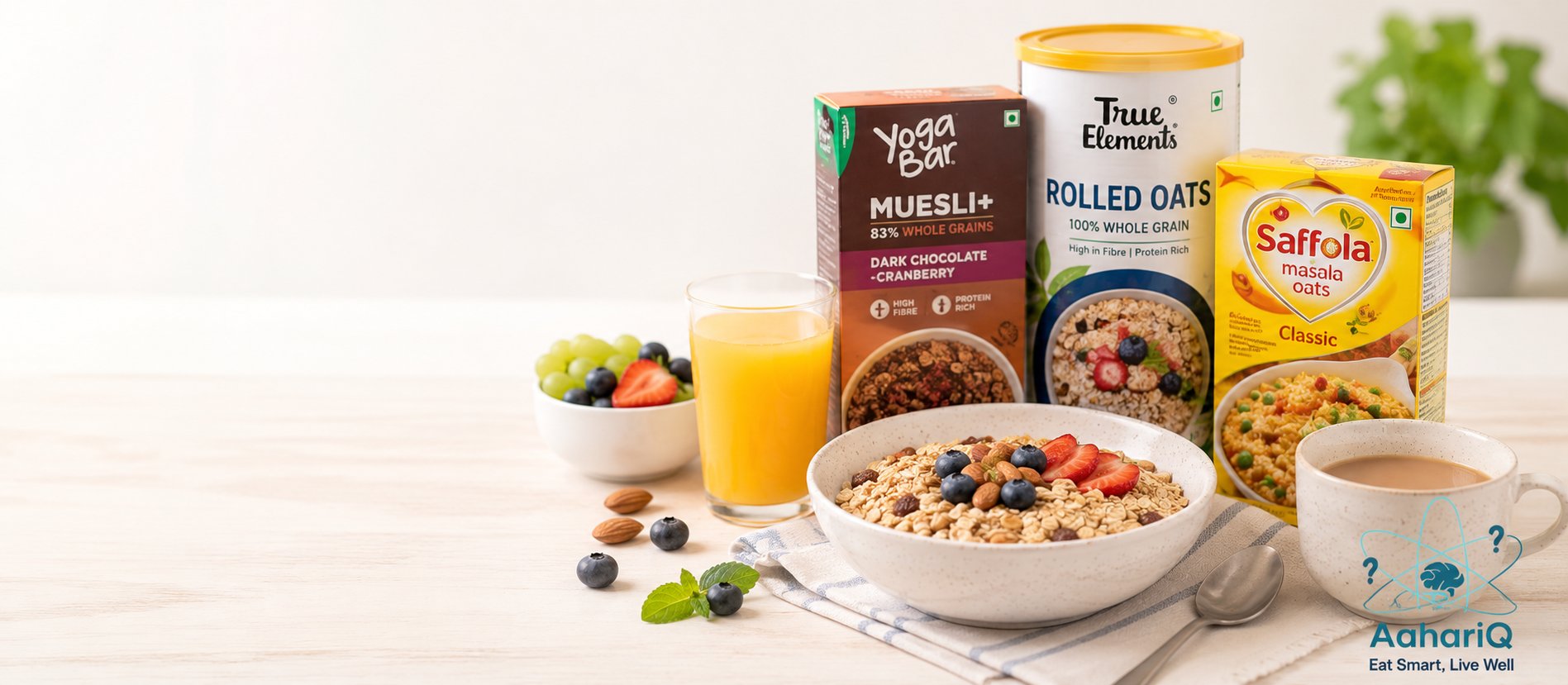
India's 'healthy' cereals, oats, and muesli often hide sugar and ultra-processed ingredients. An honest, evidence-based ranking of what's genuinely good.
Why Breakfast Matters More Than the Packaged Food Industry Claims
The statement 'breakfast is the most important meal of the day' is partially a marketing invention — specifically, it was popularised by cereal companies in the early 20th century to sell breakfast cereals. The evidence on breakfast importance is nuanced: while skipping breakfast is associated with poor dietary quality (people who skip breakfast often make up calories later with worse food choices), forced breakfast consumption for those not hungry has not been shown to improve metabolic outcomes. The quality of breakfast is far more important than whether it is eaten.
What the evidence does support is that a high-protein, high-fibre, moderate-fat breakfast with minimal added sugar provides: better blood glucose stability throughout the morning (avoiding the mid-morning energy crash that drives snack consumption), greater satiety, better cognitive performance for school and work, and better overall daily dietary pattern. This evidence base directly contradicts most Indian packaged breakfast products — which are high in refined carbohydrates, moderate-to-high sugar, and low in protein and fibre.
India's packaged breakfast market is growing rapidly at ~15% annually, driven by urbanisation, time pressure on working households, and effective marketing. The Indian packaged breakfast category includes: instant oats, flavoured oatmeal sachets, breakfast cereals (corn flakes, wheat flakes, muesli, granola), upma and poha mixes, protein-enriched cereals, and pancake/dosa mix. AaharIQ has evaluated 40+ products across these categories for nutritional quality.
Category 1: Plain Oats — The Clear Winner
Plain rolled oats (not instant, not flavoured) represent the packaged breakfast option with the strongest nutritional evidence base and the most honest ingredient list in the Indian market. Key products: Quaker Oats Original, Saffola Oats (plain), Bagrrys Oats, and local Indian oat brands. Why plain oats are nutritionally excellent:
High beta-glucan soluble fibre
beta-glucan is the most clinically validated cholesterol-lowering food component available. EFSA has approved the health claim: '3g of beta-glucan from oats per day reduces LDL cholesterol'. A 40g serving of oats provides approximately 1.5–2g of beta-glucan — eating a full portion twice daily achieves the clinically effective dose.
Low glycaemic index
whole rolled oats (GI approximately 55) produce a much slower and lower blood glucose response than corn flakes (GI >80) or instant oats with added sugar (GI >70).
Good protein content
approximately 5–6g per 40g serving, among the highest of any packaged grain product.
Contains avenanthramides
oat-specific antioxidants with anti-inflammatory properties.
Minimal processing
rolled oats are physically processed (steamed and flattened) but not chemically modified, qualifying as NOVA Group 2 (processed culinary ingredient) rather than NOVA Group 4. Avoid: Flavoured instant oat sachets (Quaker Oats 'Masala Oats', Saffola 'Tasty' flavours, Bagrrys flavoured varieties) — these typically contain significant added sugar, artificial flavours, modified starch, and high sodium.
They transform a genuinely nutritious base ingredient into a NOVA Group 4 ultra-processed product. Plain oats with home-added toppings (banana, nuts, seeds, a spoonful of honey) are categorically superior to pre-flavoured oat sachets.
Category 2: Muesli — Good Potential, Execution Varies Widely
Muesli — a mixture of rolled grains, dried fruit, nuts, and seeds — has strong nutritional potential but enormous variation in quality across Indian brands. The best muesli products are a second-tier but genuinely solid packaged breakfast option; the worst are granola bars in disguise. What to look for in Indian muesli:
Whole rolled oats as the first ingredient
not corn flakes or puffed rice, which are lower fibre and higher GI.
Added sugar under 8g per 40–50g serving. Many Indian muesli products contain 12–18g of sugar per serving, often from added honey, brown sugar, glucose syrup, and heavily sweetened dried fruit.
No chocolate-coated ingredients, chocolate chips, or candy pieces in the main muesli
these substantially increase sugar content.
Real nuts and seeds in meaningful quantities
almonds, walnuts, sunflower seeds, flaxseeds — not predominantly puffed grain with a garnish of nut.
No artificial flavours, colours, or preservatives. **Indian brands with relatively better muesli products:** Jordans Country Crisp (UK brand available in India
check for sugar), Kellogg's Muesli (check sugar), Natural Muesli by local brands, and Bagrrys premium muesli.
Always read the nutritional label and compare sugar per 100g — it varies from 8g/100g to 35g/100g across different muesli products in India.
Category 3: Breakfast Cereals — Mostly Marketing, Not Nutrition
Most Indian packaged breakfast cereals — corn flakes, wheat flakes, rice puffs, and their flavoured variants — represent a category where marketing claims and nutritional reality are most divergent. Key issues:
High glycaemic index: Corn flakes (GI ~82), puffed rice (GI ~82), and puffed wheat (GI ~74) are among the highest GI breakfast foods available — comparable to eating white bread without any nutritional benefit. The 'iron-fortified' claim on corn flakes (Kellogg's, etc.) is technically accurate but misleading — the bioavailability of added iron in fortified cereals is significantly lower than from natural food sources, and the high-GI carbohydrate load far outweighs the micronutrient benefit. Sugar content in flavoured variants: Kellogg's Honey Loops, Chocos (chocolate-flavoured corn puffs), Froot Loops India equivalent variants, and similar child-targeted cereals contain 25–40% added sugar by weight. The fibre deception: Some cereals marketed as 'high fibre' add inulin or chicory root extract (soluble fibre) to what is otherwise a low-fibre refined grain product. While not harmful, this 'fibre fortification' does not provide the same metabolic benefits as naturally occurring whole grain fibre.
Exception: Whole wheat flakes without added sugar (check: sugar <5g/100g, whole wheat as first ingredient) are a significantly better option within the breakfast cereal category — glycaemic index is lower, and whole grain provides more natural fibre and nutrients than refined corn-based cereals.
Category 4: Upma, Poha, and Indian Grain Mixes
Packaged upma mixes (semolina/rava-based), packaged poha, packaged idli-dosa batter mixes, and traditional Indian grain-based breakfast preparations represent a distinct and often more nutritionally honest category than Western-origin cereals — though quality varies significantly.
Plain packaged thin poha (flattened rice): A genuinely traditional Indian packaged breakfast ingredient. Thick poha (GI ~65) is lower GI than thin poha (GI ~75). Combined with peanuts, vegetables, and turmeric as is traditional, poha is a nutritionally complete and culturally appropriate breakfast. Packaged plain poha without additives is a NOVA Group 1–2 product — essentially just processed rice. Packaged suji/rava: Semolina (durum wheat) is a moderately processed grain. Plain semolina upma with vegetables provides protein (3–4g per serving), moderate fibre, and a lower GI than corn-based cereals. Without the ultra-processed masala mix, plain suji is a reasonable packaged breakfast ingredient. Instant upma and ready-to-eat upma mixes: These convert a reasonable grain ingredient into NOVA Group 4 by adding modified starch, artificial flavours, high sodium, and palm oil. Nutritionally inferior to plain suji prepared at home with fresh vegetables. Packaged protein-enriched upma mixes: Some brands (Sattviko, early-stage Indian health food brands) offer higher-protein variants with added dal/lentil flour. These are nutritionally superior to plain semolina mixes — more protein, better amino acid profile. Check for minimal added sugar and reasonable sodium.
AaharIQ's 2026 Indian Packaged Breakfast Ranking
Based on AaharIQ's nutritional analysis of the most widely available packaged breakfast options in India, here is our 2026 ranking:
Tier 1 — Genuinely Nutritious (Actively recommend): Plain rolled oats (any brand). Plain whole wheat flakes (<5g sugar/100g). Plain muesli with nuts and seeds (<12g sugar/50g serving). Steel-cut oats (slower to cook but highest nutritional retention). Tier 2 — Good with Caveats: Thick poha (plain). Plain suji used as cooking ingredient (not instant mix). Premium low-sugar muesli brands. Protein-enriched traditional grain mixes with minimal additives. Tier 3 — Acceptable Occasionally: Plain Marie biscuits (low additives, low nutrition). Thin poha. Fortified corn flakes without added sugar. Tier 4 — Avoid as Daily Breakfast: Flavoured instant oat sachets with added sugar. Standard corn flakes (plain). Chocolate-flavoured puffed rice cereals. High-sugar muesli products. All child-targeted cereals with >15g sugar/100g. Ready-to-eat instant upma mixes.
AaharIQ's 2026 ranking of packaged breakfast options available in India:
| Tier | Examples |
|---|---|
| Tier 1 - Genuinely Nutritious | Plain rolled oats (any brand), plain whole wheat flakes (<5g sugar/100g), plain muesli with nuts and seeds (<12g sugar/50g serving), steel-cut oats |
| Tier 2 - Good with Caveats | Thick poha (plain), plain suji used as a cooking ingredient (not instant mix), premium low-sugar muesli brands, protein-enriched traditional grain mixes with minimal additives |
| Tier 3 - Acceptable Occasionally | Plain Marie biscuits, thin poha, fortified corn flakes without added sugar |
| Tier 4 - Avoid as Daily Breakfast | Flavoured instant oat sachets with added sugar, standard plain corn flakes, chocolate-flavoured puffed rice cereals, high-sugar muesli products, child-targeted cereals with >15g sugar/100g, ready-to-eat instant upma mixes |
References
- [1]EFSA NDA Panel (2011). Scientific opinion: beta-glucans from oats and barley and LDL-cholesterol reduction — EFSA Journal. EFSA Journal.
- [2]Jenkins DJ et al. (1981). Glycemic index of foods: a physiological basis for carbohydrate exchange. American Journal of Clinical Nutrition.
- [3]Monteiro CA et al. (2019). Ultra-processed foods: what they are and how to identify them. Public Health Nutrition.
Frequently Asked Questions
The healthiest packaged breakfast options in India: plain rolled oats (Quaker, Bagrry's), unsweetened muesli with under 10g sugar per 100g, whole grain upma mixes with minimal additives, and plain poha. These provide fibre, complex carbs, and protein without the ultra-processing markers of Kellogg's-style cereals.
Without AaharIQ — you're scanning labels with your naked eye, missing hidden additives, E-numbers, and FSSAI violations that could silently harm your health over time.
🔍 Scan your food to check for best packaged breakfast India instantly
India's free AI food scanner. Detect harmful additives, FSSAI violations & allergens in any packaged food. Get a BUY or AVOID verdict in seconds.
Free tools related to this article
Author
Tags
Related Articles
 🌿
🌿Ashwagandha Leaf Ban: FSSAI's 2026 Advisory Explained
 ▲
▲The Hidden Dangers of Ultra-Processed Foods: What AI Reveals
 👶
👶Packaged Food Marketed to Children India: The Hidden Harmful Ingredients Parents Must Know
Is Kurkure Harmful? Ingredients, Health Risks & the Plastic Myth
 📋
📋