We use strictly necessary cookies to run AaharIQ, and optional functional/analytics cookies to improve it. You can accept all, reject non-essential ones, or . See our Cookie Policy for details.

Potassium Sorbate (E202) in Indian Bread & Dairy: Safe?
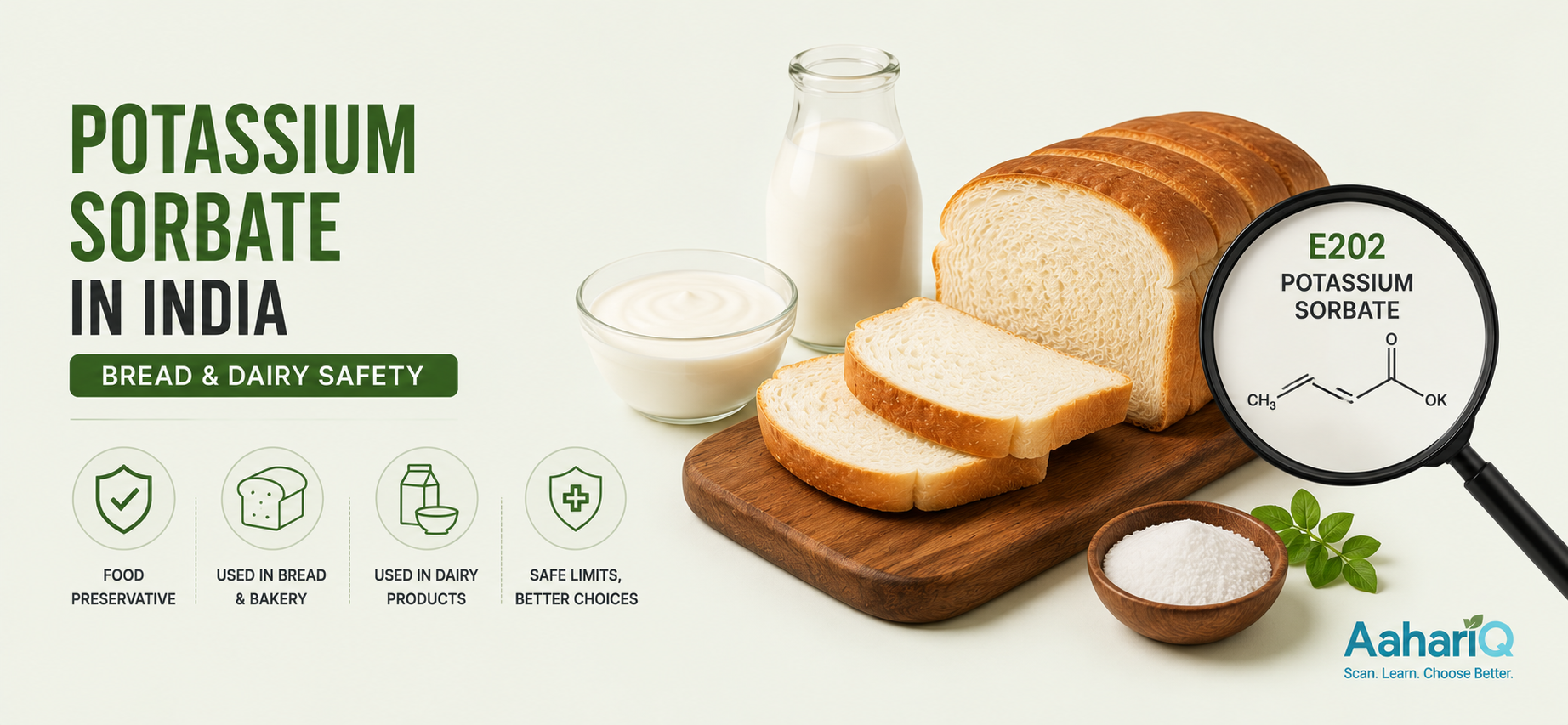
Potassium sorbate (INS 202) is India's most-used food preservative in bread and dairy. 2024 research links higher doses to gut microbiome disruption.
What Is Potassium Sorbate and Where Is It Used in India?
Potassium sorbate (chemical formula C₆H₇KO₂, INS 202, E202) is the potassium salt of sorbic acid — a naturally occurring compound first isolated from the berries of the Rowan tree (Sorbus aucuparia) in the 1850s. Today it is manufactured synthetically at industrial scale. Potassium sorbate inhibits the growth of moulds, yeasts, and some bacteria by interfering with their enzymatic processes, making it effective as a preservative at low concentrations (typically 0.1–0.3% by weight).
In India, potassium sorbate (INS 202) is one of the most widely used food preservatives. Its applications span: packaged bread and bakery products (where it prevents mould growth), processed cheese and cheese spreads, packaged paneer, yogurt and dairy desserts, packaged fruit juices and beverages, wine and fermented beverages, dried fruits, pickles and condiments, and personal care products (where it inhibits microbial contamination in formulations).
FSSAI's Food Safety and Standards (Food Products Standards and Food Additives) Regulations permit potassium sorbate in multiple food categories with specified maximum use levels. The Acceptable Daily Intake (ADI) established by JECFA and EFSA is 25 mg per kg of body weight per day — for a 60 kg adult, approximately 1,500 mg per day. Typical dietary exposure from consuming several potassium sorbate-containing foods is estimated at 15–30 mg per day for most consumers — well within the ADI.
How Potassium Sorbate Works and Why Industry Uses It
Potassium sorbate works by penetrating microbial cell membranes and inhibiting key enzymes involved in energy metabolism (specifically, enzymes in the pyruvate decarboxylation pathway). This prevents moulds and yeasts from producing the energy they need to grow and reproduce. It is selective — it inhibits moulds and yeasts effectively at low concentrations but has less activity against bacteria, which is why it is often combined with other preservatives (like calcium propionate against bacteria in bread) for broader spectrum protection. From the food manufacturer's perspective, potassium sorbate offers several advantages:
It is effective at very low concentrations (0.05–0.3%), keeping additive use minimal.
It is colourless and tasteless at use concentrations
it doesn't affect the sensory properties of the food.
It is water-soluble, making it easy to incorporate into food formulations.
It is stable across the pH range and processing temperatures typical of most packaged foods.
It is relatively inexpensive.
Without potassium sorbate (or equivalent mould inhibitors), packaged bread in India would have a shelf life of 2–3 days before visible mould growth. With potassium sorbate, packaged bread achieves 7–15 days of mould-free shelf life at typical ambient temperatures. In a country with India's climate — high humidity and temperatures that promote rapid mould growth — this shelf-life extension represents genuine practical value in reducing food waste and enabling distribution across wide geographic areas.
Safety Profile: What Regulatory Bodies Say
Potassium sorbate has one of the more extensively documented safety profiles among food additives, having been in commercial use for over 70 years. Key regulatory assessments:
JECFA (WHO/FAO): ADI of 0–25 mg/kg body weight per day, established based on animal studies showing no adverse effects at this level. Sorbate is metabolised through normal fatty acid oxidation pathways in the body. EFSA (EU): Re-evaluated sorbate in 2015 and confirmed safety. The agency noted that the ADI is rarely approached in normal dietary conditions and found no reason for concern at current use levels. US FDA: GRAS (Generally Recognised as Safe) status for potassium sorbate in food. FSSAI: Approved in multiple food categories per Food Products Standards and Food Additives Regulations. No restrictions beyond maximum use levels specified by category.
In vivo metabolism: sorbic acid (released from potassium sorbate in food) is metabolised in the liver through beta-oxidation, the same pathway used to metabolise naturally occurring fatty acids in food. The end products (CO₂ and water) are the same as those from regular fat metabolism. This metabolic pathway is a primary reason for the longstanding GRAS designation — the body handles sorbic acid like a food component rather than a foreign chemical.
How major regulatory bodies have assessed potassium sorbate (INS 202):
| Regulator | Assessment |
|---|---|
| JECFA (WHO/FAO) | ADI of 0-25 mg/kg body weight per day, based on animal studies showing no adverse effects at this level |
| EFSA (EU) | Re-evaluated in 2015 and confirmed safety; ADI rarely approached under normal dietary conditions |
| US FDA | GRAS (Generally Recognised as Safe) status |
| FSSAI (India) | Approved in multiple food categories with maximum use levels specified per category |
2024 Research: Gut Microbiome Disruption and Inflammatory Markers
Despite its long history of regulatory approval, new research in 2024 has raised questions about potassium sorbate's effects at higher doses that are relevant for heavy consumers of preserved packaged foods. A 2024 mouse study exposing animals to varying concentrations of potassium sorbate for 10 weeks found:
No significant changes in organ weight or basic metabolic parameters at doses within and around the ADI.
Increased inflammatory markers (specifically elevated liver enzymes and inflammatory cytokines) at higher doses.
Shifts in gut microbiota composition, particularly a reduction in Lactobacillus species.
Importantly, when potassium sorbate was removed from the diet for 5 weeks, these changes reversed
suggesting that the effects are transient and reversible at these doses, and do not represent permanent damage. This reversibility is a positive finding compared to studies with some other additives. A 2024 risk assessment study in Iran (measuring potassium sorbate exposure from packaged Iranian food products and comparing to ADI) found that average adult exposures remained well within the ADI, but that children and heavy consumers of potassium sorbate-rich products (bread, dairy, beverages) could approach or exceed the ADI. Children's lower body weight means the same milligram exposure represents a higher mg/kg dose — a key consideration for families with young children who consume multiple preserved packaged foods daily.
The genotoxicity literature on potassium sorbate is mixed. Several older in vitro studies found that potassium sorbate could cause chromosomal aberrations and DNA strand breaks in cell culture at high concentrations — but these concentrations were far above those found in food. More recent studies using biologically relevant concentrations (reflecting actual dietary exposure) have generally not confirmed genotoxicity. The current scientific consensus does not classify potassium sorbate as genotoxic at dietary exposure levels.
Potassium Sorbate in Bread: The Daily Exposure Reality for Indian Consumers
For millions of urban Indian consumers who eat packaged bread daily — whether as toast at breakfast, in sandwiches at lunch, or as a dinner accompaniment — potassium sorbate (INS 202) is consumed with almost every bread consumption event. Major Indian bread brands including Britannia, Harvest Gold, English Oven, and most regional bakery brands use potassium sorbate to achieve extended shelf life.
A typical 50g serving of commercially produced Indian white bread (2–3 slices) contains approximately 25–50 mg of potassium sorbate. Two such servings per day (a reasonable daily bread consumption for urban families) contributes approximately 50–100 mg of potassium sorbate from bread alone. Combined with potassium sorbate from packaged paneer, packaged cheese, fruit juices, and other dairy products consumed in the same day, total daily exposure can reach 100–200 mg for active urban consumers — well within the ADI of 1,500 mg for a 60 kg adult, but representing more than trivial exposure that accumulates over years of daily consumption.
The case for home-baked bread or fresh bread from local bakeries (which do not require the same shelf life) is partly one of reducing unnecessary preservative exposure. Fresh bread baked without preservatives and consumed within 1–2 days is nutritionally and microbiologically equivalent to commercial bread without the potassium sorbate. For families who have the time and inclination, home bread making significantly reduces potassium sorbate exposure from this single source.
AaharIQ Verdict on Potassium Sorbate
Potassium sorbate (INS 202) is one of the better-studied and generally safer food preservatives in use. Regulatory bodies globally have maintained its approval based on a solid evidence base, and its ADI is rarely approached through typical dietary exposure. The 2024 research adds nuance — at higher doses, reversible gut microbiome disruption and inflammatory markers have been observed — but these are not at levels typically achieved through food consumption. AaharIQ's assessment: potassium sorbate is not a high-priority health concern for most consumers. It is appropriate to use minimally processed preservative-free alternatives when convenient (fresh bread from bakeries, fresh dairy from trusted local sources), but alarm about INS 202 in packaged bread or cheese is not warranted by current evidence. Where care is warranted:
For children who consume multiple potassium sorbate-containing products daily
the mg/kg exposure is higher relative to ADI.
For people with known sensitivity to sorbates (skin reactions from topical sorbate in cosmetics are documented; some individuals may have similar sensitivity to sorbate in food).
As a motivation to reduce overall packaged food dependence
choosing fresh bread, fresh dairy, and fresh produce over preserved alternatives is a health-positive direction regardless of preservative concerns.
References
- [1]EFSA ANS Panel (2015). Re-evaluation of sorbic acid (E 200) and potassium sorbate (E 202) as food additives. EFSA Journal.
- [2]Masda Chemicals (2024). Potassium sorbate: safe preservative or health concern?. Masda Chemicals Industry Blog.
- [3]Nutraceuticals International (2024). FSSAI clamps down on e-commerce sites selling health drinks. Nutraceuticals International.
Frequently Asked Questions
EFSA confirmed potassium sorbate (E202) is safe at approved use levels in its 2015 re-evaluation. The ADI is 25 mg/kg body weight. It is one of the gentler and better-studied preservatives. Individual sensitivity is rare. At typical dietary exposures from bread and dairy, it is not a health concern for most people.
Without AaharIQ — you're scanning labels with your naked eye, missing hidden additives, E-numbers, and FSSAI violations that could silently harm your health over time.
🔍 Scan your food to check for potassium sorbate India instantly
India's free AI food scanner. Detect harmful additives, FSSAI violations & allergens in any packaged food. Get a BUY or AVOID verdict in seconds.
Free tools related to this article
Author
Tags
Related Articles
 ⬡
⬡How AI Is Transforming Food Safety for People with Chronic Conditions
 🦋
🦋Thyroid Patients: Which Packaged Foods to Avoid?
 🧪
🧪Food Adulteration in India 2026: How to Detect Fake Milk, Honey, Ghee & Spices at Home
 ◆
◆Artificial Sweeteners and Health: A Deep Dive with AI Analysis
 🦠
🦠