We use strictly necessary cookies to run AaharIQ, and optional functional/analytics cookies to improve it. You can accept all, reject non-essential ones, or . See our Cookie Policy for details.

Is Your Paneer Real? FSSAI Found 83% Fail Safety Tests
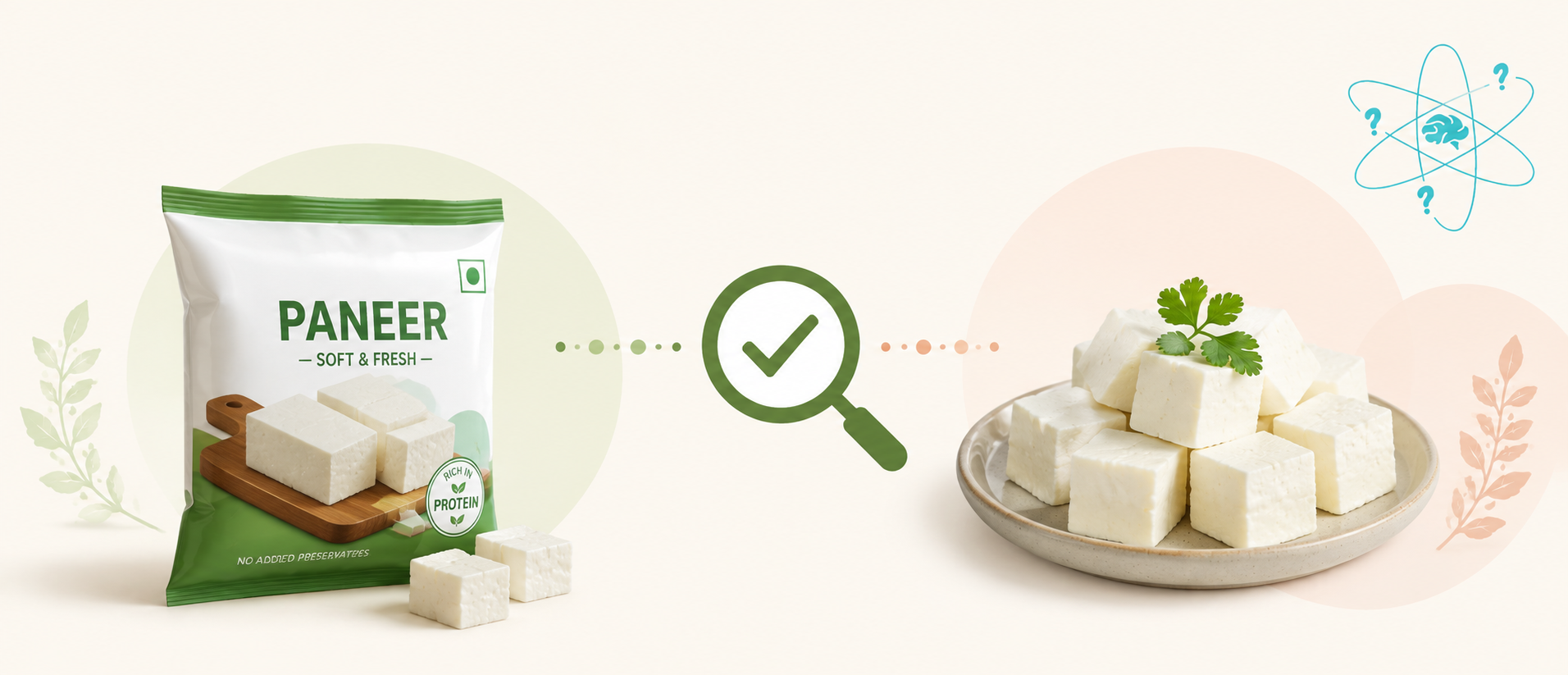
FSSAI found 83% of paneer samples failed safety standards in 2024-25, with 40% unsafe to eat. Here's how to spot adulterated paneer at home.
Why This Matters
Paneer occupies a unique place in Indian vegetarian diets as one of the few widely accessible, high-protein, complete-protein foods — which makes the scale of documented adulteration genuinely consequential rather than a minor quality-control footnote. The most recent FSSAI data showing 83% of samples failing safety standards, with 40% outright unsafe, means the average paneer purchase in India carries real, quantified risk rather than a theoretical one. This guide covers what's actually being added to fake or diluted paneer, what the real regulatory standards require, and which home tests genuinely work versus which are more folklore than reliable detection.
India's Paneer Crisis: Adulteration Is Widespread and Documented
Paneer — fresh Indian cheese made by curdling hot milk with an acid (lemon juice, vinegar, or whey) and pressing the curds — is one of India's most important protein foods, particularly for vegetarian households. The Indian paneer market is valued at approximately ₹8,000–10,000 crore annually, divided between branded packaged paneer (Amul, Mother Dairy, Verka, local dairy brands), loose paneer from local shops, and restaurant-made paneer.
FSSAI's annual food safety surveys consistently identify paneer as one of the most frequently adulterated food products in India. The most recent FSSAI inspection data (April 2024 - March 2025) found 83% of paneer samples failed food safety standards, with 40% found outright unsafe for human consumption — a marked increase in documented severity compared to earlier surveys, driven by adulteration, microbiological contamination, and compositional failures. The adulteration problem is most severe in loose, unpackaged paneer from small shops and markets; branded packaged paneer from major dairies generally has better compliance, though is not immune.
Common Paneer Adulterants: What's Actually Being Added
Starch (potato, arrowroot, wheat starch): The most common paneer adulterant. Added to increase the bulk and weight of paneer without proportional milk use. Starch increases the yield from a given quantity of milk, allowing manufacturers or shops to sell adulterated paneer at lower cost while appearing competitive. Starch adulteration reduces the protein and fat content per gram of product — the consumer is paying for paneer protein/fat but getting cheaper starch carbohydrate. Detection: Add a drop of iodine solution to a small piece of paneer — blue/black colour indicates starch presence (iodine turns blue in presence of starch). Vegetable oils and hydrogenated fats (vanaspati): Some paneer is adulterated with vegetable oil mixed into the curd during pressing to increase fat content while reducing milk fat content — cheaper fats substituting for genuine milk fat. This changes the fatty acid profile (introducing trans fats from vanaspati) and reduces the nutritional quality. Urea: Added to some dairy products to inflate apparent protein content in testing (similar to protein spiking in protein supplements — urea is high nitrogen). Completely non-food chemical; health risks at high doses. Detergent residues: Some paneer produced in non-hygienic conditions carries detergent residues from inadequately rinsed equipment — contributing to microbiological and chemical contamination. Refined flour (maida): Used like starch to bulk out paneer, particularly in loose market paneer and restaurant paneer.
FSSAI's Paneer Standards: What Genuine Paneer Must Meet
FSSAI's Food Safety and Standards (Food Products Standards and Food Additives) Regulations specify compositional requirements for paneer:
Fat content: Minimum 50% fat on dry matter basis (for full-fat paneer). This means the fat content of the non-water portion of paneer must be at least 50% fat.
Total solid content: Minimum 72% total solids (i.e., maximum 28% moisture).
Acidity: Not more than 0.5% (expressed as lactic acid).
No added starch, artificial colouring, or non-dairy solids.
Microbiological standards: Coliform count, yeast/mould count, and total plate count limits specified.
Packaged paneer sold under FSSAI regulations must meet these compositional standards and microbiological requirements. FSSAI product approval (FSSAI licence number visible on packaging) is a baseline requirement for all packaged paneer in legal trade. Products without FSSAI licensing are technically illegal to sell.
Branded vs Unbranded Paneer: Quality Assessment
Major branded packaged paneer brands in India and their compliance track record: Amul Paneer: India's largest dairy cooperative brand. Amul has robust quality control systems and regular FSSAI compliance audits. Amul packaged paneer has historically been among the most reliable in terms of compositional compliance. Fat content and microbiological safety are generally consistent. Available nationally. Mother Dairy Paneer: Delhi-NCR's dominant dairy brand, operated under NDDB. Similar quality standards to Amul. Strong cold chain management. Verka (Punjab): Punjab Dairy Development Board brand. Regional dominance, generally good compliance. Nandini (Karnataka): Karnataka Milk Federation brand. South India distribution. Regional private brands: Vary significantly; check for FSSAI licence number and cold storage condition at point of purchase. Loose/unbranded paneer from local shops and markets: Highest adulteration risk. FSSAI surveys consistently find higher non-compliance rates in loose paneer than branded. Not recommended without verifiable source traceability. The economic incentive to adulterate is highest in this segment (no branded reputation to protect, higher margin from adulteration, less regulatory scrutiny).
Quick Home Tests for Paneer Adulteration
AaharIQ provides a set of quick home tests that can identify the most common paneer adulterants without a laboratory:
Starch test (most important): Boil a small piece of paneer in water. Cool to room temperature. Add 2–3 drops of iodine solution (available at pharmacies as antiseptic). A blue or black colour change indicates starch adulteration. No colour change (iodine remains yellow-orange) indicates no starch. Vegetable oil/synthetic solid test: Take a small piece of paneer. Try to stretch it between fingers. Genuine paneer should break easily with a granular texture. Adulterated paneer with synthetic milk solids or vegetable oil additions tends to be rubbery, stretchy, or unusually smooth in texture. This is a qualitative indicator only, not definitive. Washing soda/synthetic additives: Dissolve a small quantity in water. Add a few drops of lemon juice. Genuine paneer in acidic solution should not show fizzing. Fizzing indicates washing soda or alkali added for texture stabilisation. Fat test (qualitative): Press a piece of paneer on white paper and leave for 5 minutes. A good paneer will leave an oily/fatty mark. Excessively dry paneer with no fat mark may indicate low-fat adulteration or starch bulking. AaharIQ recommends: Always purchase branded packaged paneer from FSSAI-licensed dairies. Store paneer below 4°C and consume within 3–5 days of opening. Look for signs of sourness, unusual texture, or unusual smell before use.
AaharIQ's summary of the quick home tests described above:
| Test | What It Detects | Positive Result |
|---|---|---|
| Iodine test | Starch adulteration | Blue or black colour change |
| Stretch test | Vegetable oil or synthetic milk solids | Rubbery, stretchy, or unusually smooth texture instead of a granular break |
| Lemon juice test | Washing soda/alkali additives | Fizzing in acidic solution |
| Paper press test | Fat content / starch bulking | No oily mark left on paper may indicate low-fat or starch adulteration |
Why Loose Paneer Carries So Much More Risk Than Branded
The economics behind the branded-versus-loose gap are straightforward and worth understanding rather than just accepting as a rule of thumb. A branded dairy with national distribution has a reputation asset that adulteration directly threatens — a single viral adulteration scandal can meaningfully damage a brand built over decades, creating a real incentive to maintain compliance even where enforcement is inconsistent. A small local shop selling loose paneer has no comparable brand equity at stake, faces lower probability of being specifically tested, and captures a larger margin from bulking product with starch or cheap fat than a large dairy operating at thinner, volume-driven margins would. None of this means every loose paneer vendor adulterates, or every branded product is automatically pure — but the structural incentives genuinely differ, which is why FSSAI's own survey data consistently shows loose paneer failing at higher rates than branded packaged product.
What "Analogue" Paneer Actually Is
Beyond simple dilution — real paneer bulked out with starch or cheap fat — a more severe category of adulteration involves products with little to no actual milk content at all, built primarily from vegetable fat, starch, and emulsifiers to mimic paneer's texture and appearance. This isn't a grey-area quality issue; it's effectively a different product marketed deceptively as paneer, and it carries none of paneer's actual nutritional value — the protein content that makes paneer valuable in a vegetarian diet is largely or entirely absent. This category is harder to detect with simple home tests than starch-diluted real paneer, since it's engineered specifically to pass a casual visual and textural inspection, which is precisely why sourcing from a traceable, reputable brand matters more for this specific risk than for simpler dilution-style adulteration.
A Realistic Buying and Storage Checklist
Checking for an FSSAI licence number on packaging is the baseline, non-negotiable first check — its absence means the product is being sold illegally regardless of any other quality question. Beyond that: genuine paneer should have a slightly grainy, not perfectly smooth or rubbery, texture when broken; it should smell mildly milky, not sour, chemical, or absent of any smell at all (a complete absence of smell can itself be a sign of synthetic composition); and it should leave a visible fat mark when pressed on paper, per the test covered above. After purchase, storage below 4°C and consumption within 3-5 days of opening matters for both quality and genuine food safety, since paneer's high moisture and protein content make it a favourable medium for bacterial growth once contaminated or left at room temperature. None of the home tests covered in this guide are lab-grade definitive — they're practical screening tools, and a consistently reliable, traceable source remains a stronger safeguard than testing an already-purchased product after the fact.
What to Do If You Suspect Adulterated Paneer
FSSAI maintains a food safety complaint mechanism -- both a toll-free helpline and an online portal -- specifically for reporting suspected adulteration, and complaints that include a retained sample and purchase receipt carry more weight for triggering an actual inspection than a description alone. For anyone who has purchased paneer and has genuine health concerns after consuming it -- unusual gastrointestinal symptoms shortly after eating a specific batch, for instance -- retaining the remaining product and packaging rather than discarding it immediately preserves the option to report it formally. At a household level, switching to a single trusted, consistent source -- whether a specific branded product or a local shop with a track record -- and treating a sudden change in taste, texture, or smell from that usual source as a warning sign rather than dismissing it, is a more practical everyday safeguard than testing every single purchase from scratch.
References
- [1]FSSAI (2022). Annual Food Safety and Standards Survey — Milk and Dairy Products Adulteration Report. FSSAI India.
- [2]Patel A et al. (2020). Food adulteration in India: an overview. Journal of Food Science and Technology.
Frequently Asked Questions
Loose paneer has high adulteration rates (FSSAI surveys find 60%+ non-compliant). Branded packaged paneer (Amul, Mother Dairy, Verka) has much lower adulteration risk due to cold chain management, FSSAI audits, and brand accountability. Prefer packaged branded paneer from refrigerated sections.
Without AaharIQ — you're scanning labels with your naked eye, missing hidden additives, E-numbers, and FSSAI violations that could silently harm your health over time.
🔍 Scan your food to check for packaged paneer India quality instantly
India's free AI food scanner. Detect harmful additives, FSSAI violations & allergens in any packaged food. Get a BUY or AVOID verdict in seconds.
Free tools related to this article
Author
Tags
Related Articles
 ⬡
⬡How AI Is Transforming Food Safety for People with Chronic Conditions
 ◆
◆Artificial Sweeteners and Health: A Deep Dive with AI Analysis
 👶
👶Packaged Food Marketed to Children India: The Hidden Harmful Ingredients Parents Must Know
 ❋
❋Personalized Nutrition: Why One Diet Cannot Work for Everyone
 🎨
🎨