We use strictly necessary cookies to run AaharIQ, and optional functional/analytics cookies to improve it. You can accept all, reject non-essential ones, or . See our Cookie Policy for details.

Open Food Facts vs AaharIQ: Why India Needs a Local Food Scanner

Open Food Facts is trusted globally but fails India on barcode coverage, FSSAI alignment, and health personalisation. Here is the honest comparison.
Open Food Facts is genuinely one of the best things to happen to food transparency in the last decade. It is open-source, entirely community-driven, refuses advertising, and has built a database of over 4 million food products from 150+ countries. For a health-conscious person in France or the UK, it is close to indispensable. For an Indian consumer scanning Indian packaged food at a supermarket? It falls short in ways that directly affect the quality of information you receive.
This is not a criticism of Open Food Facts — it is a reflection of the fundamental challenge of building a universal food database for a country as large, diverse, and food-complex as India. Understanding where it falls short — and where AaharIQ picks up — helps you use the right tool for the right job.
Where Open Food Facts Excels
Open Food Facts has three genuinely outstanding qualities that make it a respected tool globally:
Complete independence. No advertising. No brand partnerships. No commercial relationships with the food industry. The data is contributed by volunteers and remains open for anyone to use, verify, and improve.
Scientific credibility. Open Food Facts uses Nutri-Score — a validated, peer-reviewed nutritional grading system — and NOVA classification, the internationally respected system for identifying ultra-processed foods. Both are backed by substantial research.
Transparency. Every data point is auditable. You can see who contributed a product's information, when it was last updated, and what the source is. This is a standard of transparency that commercial apps rarely match.
These qualities make Open Food Facts the gold standard for food database integrity. The problem is not its values — it is its Indian product coverage.
Where Open Food Facts Fails Indian Consumers
1. Missing Indian Products
Open Food Facts' 4 million product database sounds enormous, but the Indian subset is disproportionately small. Scanning a packet of Haldiram Bhujia, Parle Krackjack, Sunfeast Dark Fantasy, any regional namkeen brand, or most Indian health food products returns either 'product not found' or incomplete data entered by a volunteer years ago.
The volunteer contribution model that works brilliantly in Western European countries — where many tech-savvy users scan the same supermarket products and contribute data — works less well for the full breadth of India's packaged food market, which includes thousands of regional brands, state-specific products, and tier-2 city goods that may never attract enough volunteer contributors to have complete database entries.
2. Incomplete and Inaccurate Indian Data
When Indian products are in the Open Food Facts database, the quality of data is inconsistent. Volunteer-contributed data often includes:
• Missing ingredient lists — the most important information for safety analysis
• Incorrect barcode entries — multiple products sharing the same barcode or wrong products matched to a barcode
• Outdated information — manufacturers regularly reformulate products, but Open Food Facts entries may reflect formulations from years ago
• Missing additive E-numbers — ingredient lists entered as plain text rather than parsed against an additive database
For food safety purposes, incomplete data is arguably worse than no data — it creates a false sense of security about products whose full ingredient list has not been captured.
3. No FSSAI Alignment
Open Food Facts uses Nutri-Score (a French nutritional grading system) and NOVA classification (a Brazilian food processing framework developed at the University of São Paulo) — both calibrated for Western dietary contexts, not Indian regulatory standards. They are good systems, but they are not calibrated for Indian regulatory standards. FSSAI has different permissible limits for additives, different banned substance lists, and different nutritional reference daily values than the European frameworks Open Food Facts uses.
For an Indian consumer, the relevant question is not 'does this meet European nutritional standards?' but 'does this comply with FSSAI guidelines, and what does ICMR research say about its health impact in the Indian context?' Open Food Facts cannot answer that question.
4. No Health-Condition Personalisation
Open Food Facts shows the same Nutri-Score grade to every user regardless of their health status. A product graded B by Nutri-Score might be appropriate for a healthy adult but genuinely dangerous for a diabetic patient (hidden high-GI starches), a PCOS patient (xenoestrogens and inflammatory additives), or a person with kidney disease (phosphate additives). Open Food Facts has no mechanism for personalising its guidance to your health situation.
AaharIQ: What an India-First Food Scanner Looks Like
AaharIQ was designed to solve precisely the problems that Open Food Facts cannot address for Indian consumers. Rather than adapting a global system for India, it was built from the ground up with Indian products, Indian regulations, and Indian health challenges at its core.
Indian Product Database Built for India
AaharIQ's database focuses exclusively on Indian packaged food products. This means its team has put resources into scanning, cataloguing, and verifying the Indian brands that Open Food Facts volunteers have not covered — regional snack brands, Indian health food companies, Ayurvedic packaged products, and the thousands of products that exist only in the Indian grocery ecosystem. The result is scan recognition rates for Indian products that are significantly higher than Open Food Facts.
FSSAI-Aligned Analysis
Every ingredient AaharIQ analyses is evaluated against FSSAI standards — the regulatory framework that actually governs what is legal in Indian food. When FSSAI bans an additive, updates a permissible limit, or issues an enforcement notice against a specific brand or product, AaharIQ's analysis reflects that. This is the standard of regulatory alignment that Indian consumers deserve.
Disease Prevention Intelligence That Open Food Facts Cannot Offer
This is the dimension where the comparison most clearly favours AaharIQ. Beyond ingredient identification and nutritional scoring, AaharIQ provides:
• Condition-specific risk scoring — your health profile shapes every scan result, so a diabetic patient sees glucose impact warnings that a healthy user may not need
• Long-term risk projection — repeated consumption of certain ingredient combinations is flagged with cumulative risk assessment, not just per-product evaluation
• Mechanism-level explanation — AaharIQ does not just say an ingredient is harmful; it explains how it disrupts your metabolism, hormonal system, or gut microbiome
• India-specific disease context — the app is calibrated against ICMR data on disease prevalence in India, so its risk assessments reflect the actual health risks of Indian consumers
When to Use Open Food Facts vs AaharIQ
| Use Case | Open Food Facts | AaharIQ |
|---|---|---|
| Scanning Indian brands | Often missing | Comprehensive coverage |
| FSSAI-compliant ratings | Uses EU frameworks | FSSAI-aligned |
| Checking if product is ultra-processed | NOVA classification | Equivalent analysis |
| Health condition personalisation | Not available | 7+ conditions |
| Ingredient safety explanation | Basic flags only | Mechanism of harm |
| Data independence | Fully open source | No brand partnerships |
| Regional Indian brands | Very limited | Good coverage |
| Current FSSAI enforcement data | Not integrated | Updated regularly |
The Honest Assessment
If Open Food Facts has the product you are scanning with complete, accurate data, it is a trustworthy source — its independence and scientific rigour are genuine. The problem is that for most Indian packaged food products, it will not have that data. And when it does not, you either get no information or misleading partial information.
AaharIQ is not trying to replace Open Food Facts globally — it is trying to do one thing better than any global app can: give Indian consumers accurate, personalised, FSSAI-aligned food safety intelligence for the actual products on Indian shelves. On that specific goal, it succeeds where Open Food Facts cannot.
India has 1.4 billion people, millions of them managing serious dietary-linked health conditions, eating packaged food sold by companies spending crores on marketing that often obscures more than it reveals. The solution to that problem is not a European open-source database built by volunteers. It is a purpose-built Indian food intelligence tool that was designed with Indian consumers' health as its sole mission.
AaharIQ is free. Your health is not cheap. Download it and start making every grocery decision with accurate, independent, India-specific information. Available on Google Play Store and Apple App Store.
Frequently Asked Questions
Open Food Facts works partially in India. Its 4 million product database has very limited Indian coverage — most regional brands, local namkeen, and tier-2 city products are absent. When Indian products are listed, the data is often incomplete or outdated. For everyday Indian grocery shopping, it is not a reliable primary scanner.
Without AaharIQ — you're scanning labels with your naked eye, missing hidden additives, E-numbers, and FSSAI violations that could silently harm your health over time.
🔍 Scan your food to check for open food facts india instantly
India's free AI food scanner. Detect harmful additives, FSSAI violations & allergens in any packaged food. Get a BUY or AVOID verdict in seconds.
Free tools related to this article
Author
Tags
Related Articles
 🧈
🧈Is Amul Butter and Ghee Safe? Ingredients, Adulteration Tests & Health Check India 2026
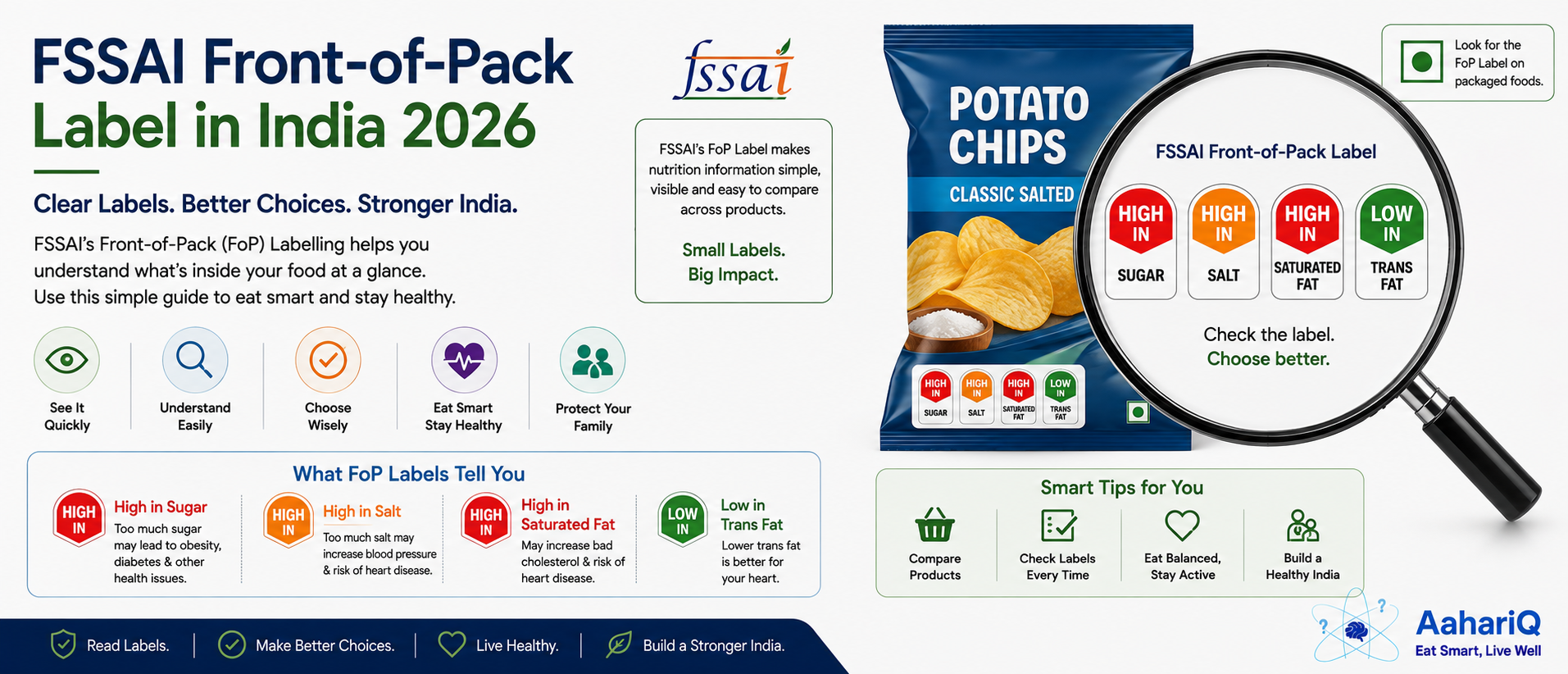 📋
📋FSSAI Front-of-Pack Warning Labels: What's Coming in 2026
 ▲
▲The Hidden Dangers of Ultra-Processed Foods: What AI Reveals
 ✧
✧The Future of Precision Health: AI, Genomics, and Nutrition Converging
 ❤️
❤️