We use strictly necessary cookies to run AaharIQ, and optional functional/analytics cookies to improve it. You can accept all, reject non-essential ones, or . See our Cookie Policy for details.

Modified Starch in Indian Food: The Blood Sugar Risk
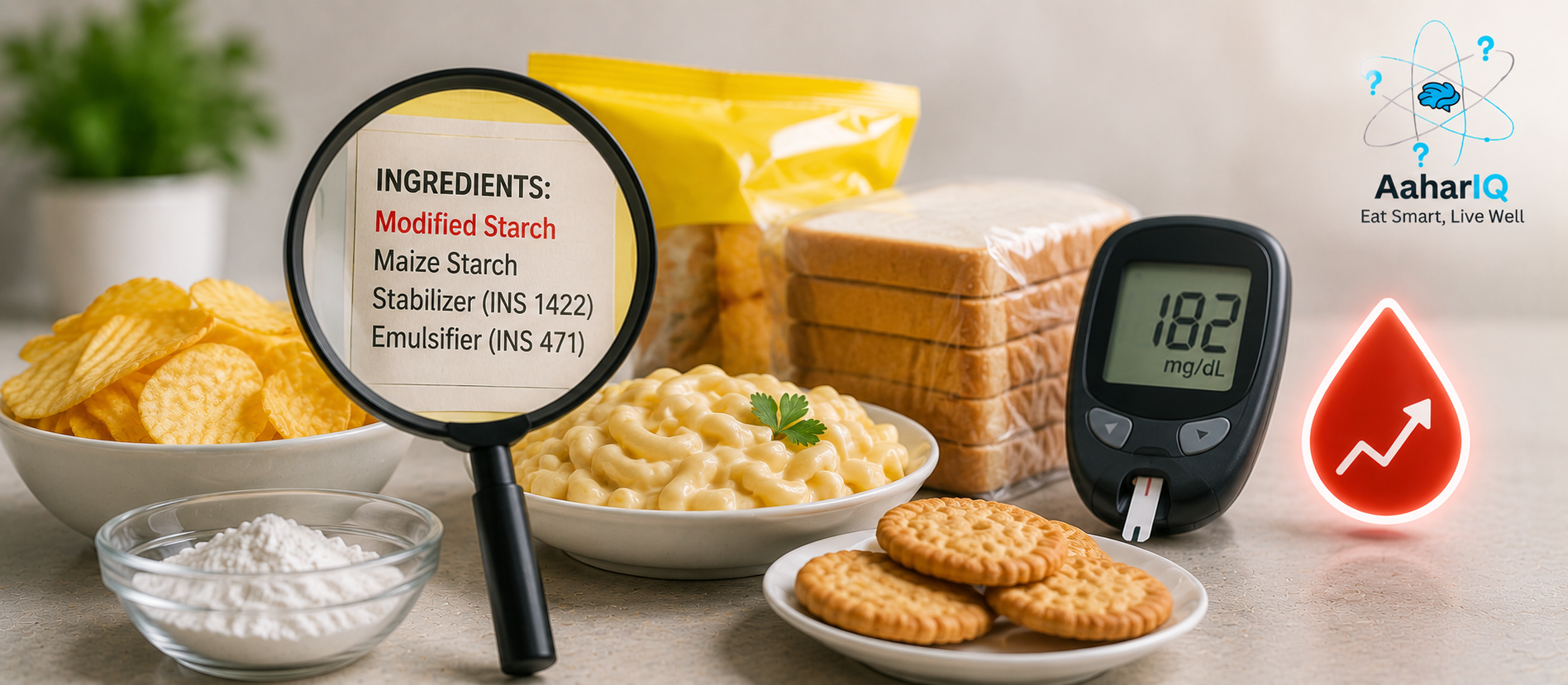
Modified starch (INS 1400-1450) in Indian biscuits, noodles, and baby food has a GI above 85, spiking blood sugar faster than table sugar itself.
What Is Modified Starch and Why Is It in Everything?
Starch is a carbohydrate found in grains, legumes, roots, and tubers. In its native form (e.g., corn starch, potato starch, tapioca starch), starch can gel when heated and break down over time — which is problematic for industrially manufactured food that needs to maintain consistent texture across months of shelf life, extreme temperature changes, and multiple processing stages. Modified starch solves this problem: by applying physical, chemical, or enzymatic treatments to native starch, manufacturers create starch derivatives with tailored functional properties.
Modified starches carry INS numbers in the 1400–1450 range under FSSAI regulations (corresponding to E1400–E1452 in the EU). The most common types include: acid-treated starch (INS 1401), bleached starch (INS 1402), oxidised starch (INS 1404), mono-starch phosphate (INS 1410), di-starch phosphate (INS 1412), hydroxypropyl starch (INS 1440), and hydroxypropyl distarch phosphate (INS 1442). Each modification changes how the starch behaves during processing and in the final product.
Modified starches appear in an enormous range of Indian packaged foods: cup noodles and instant soups (for thickening), packaged gravies and curry bases, dairy desserts (gulab jamun mixes, kheer mixes, ice cream), biscuits and cakes, baby food products, salad dressings and mayonnaise, packaged dips and sauces, and powdered drink mixes. They are so ubiquitous in the food industry that it is virtually impossible to eat packaged food regularly without consuming them.
Common modified starches found on Indian food labels and their INS numbers:
| INS Number | Name | Modification Type |
|---|---|---|
| INS 1401 | Acid-treated starch | Acid treatment |
| INS 1402 | Bleached starch | Bleaching |
| INS 1404 | Oxidised starch | Oxidation |
| INS 1410 | Mono-starch phosphate | Phosphorylation |
| INS 1412 | Di-starch phosphate | Cross-linking (phosphated) |
| INS 1440 | Hydroxypropyl starch | Hydroxypropylation |
| INS 1442 | Hydroxypropyl distarch phosphate | Hydroxypropylation plus cross-linking |
The Blood Sugar Problem: How Modified Starch Compares to Regular Carbohydrates
The primary health concern with modified starch in the context of Indian dietary patterns is its impact on blood glucose and insulin. When starch is digested, it is broken down into glucose molecules that enter the bloodstream — this process is measured by the glycaemic index (GI) and glycaemic load (GL). Refined starches (like maida from white flour) already have higher GI than whole grain starches. Modified starches can have even faster digestion kinetics depending on the type of modification.
Specifically: oxidised starch (INS 1404) and acid-treated starch (INS 1401) have altered granule structures that can increase the rate of enzyme access during digestion, potentially elevating the GI compared to native starch. Hydroxypropyl starches (INS 1440, 1442) are more resistant to gelatinisation, which can slow digestion slightly. Cross-linked starches (phosphated) tend to be more stable but still digestible. The net effect depends on the specific modification and the food matrix.
In practice, the concern is less about one specific modified starch ingredient and more about the cumulative starch load in ultra-processed foods. A typical Indian cup noodle serving contains approximately 30–35g of refined maida-based noodles plus modified starch in the thickened masala — together creating a high-starch, high-glycaemic meal with minimal fibre or protein to moderate the blood sugar spike. For the 101 million Indians living with type 2 diabetes, and the estimated additional 136 million with prediabetes, these cumulative glycaemic effects from multiple daily servings of starch-heavy processed foods are clinically meaningful.
Modified Starch as a NOVA Group 4 Marker
Under the NOVA classification system, modified starches are explicitly listed as NOVA Group 4 ingredients — substances that are not found in a home kitchen and are characteristic of ultra-processed foods. The presence of modified starch in an ingredient list is one of the reliable markers that a product has been industrially processed beyond what is necessary for basic food preservation or preparation.
Modified starch's primary function in food manufacturing is to enable the production of foods that would not be possible with naturally occurring ingredients: instant gravies that reconstitute perfectly in 30 seconds, cup noodles that maintain texture for 5 minutes after preparation, dairy desserts that stay smooth and non-separating for 6 months. These functional benefits serve the industrial food system's needs for mass production and long shelf life — not the consumer's nutritional needs.
The NOVA framework's concern is not that modified starch is directly toxic (at FSSAI and Codex permitted levels, it is not). The concern is that the presence of modified starch, along with other NOVA Group 4 markers (artificial flavours, emulsifiers, excessive salt, fortification to compensate for stripped nutrients), indicates that a food has been assembled from industrial ingredients in ways that collectively affect health outcomes beyond what any single ingredient analysis can capture.
Population-level evidence now firmly establishes that higher NOVA Group 4 food consumption is associated with obesity, type 2 diabetes, cardiovascular disease, and multiple cancers — not necessarily because any single ingredient like modified starch is directly responsible, but because the overall dietary pattern of high ultra-processed food consumption displaces more nutritious minimally processed foods and creates addictive eating patterns driven by engineered palatability.
Modified Starch in Baby Food: A Special Concern for Indian Parents
One of the most sensitive areas of modified starch use is in commercial baby food and infant cereal products. Packaged baby cereals (such as Nestlé Cerelac, Heinz infant cereals, and various Indian brands) commonly contain modified starch as a thickening agent and texture modifier. This is concerning for several reasons specific to infant feeding.
Infants' digestive systems produce amylase (the enzyme that breaks down starch) in limited quantities before approximately 6 months of age. Some modified starches are specifically designed to be easily digested even with low amylase activity — this sounds beneficial, but means they are digested rapidly and can cause faster blood sugar spikes in infants whose metabolic systems are still developing. The WHO and UNICEF recommend exclusive breastfeeding for 6 months, with complementary foods introduced after — and when complementary foods are introduced, the WHO recommends nutrient-dense whole foods rather than ultra-processed packaged baby cereals.
Nestlé's Cerelac (India) received significant attention in 2024 when a Public Eye report alleged that Nestlé adds significant amounts of added sugar to its baby products in India and other developing countries, which the company does not do for the same products sold in European markets. FSSAI investigated and found the added sugar levels were within Indian regulatory limits — but this highlighted the same regulatory asymmetry concern: Indian infants and children are exposed to formulations that would not be sold in Europe.
For parents of infants and toddlers, AaharIQ recommends checking baby food labels carefully for modified starch (look for INS numbers in the 1400–1450 range) and added sugar, and consulting a paediatrician or certified nutritionist for guidance on complementary feeding rather than relying on packaged baby food marketing.
Resistant Starch: When Modification Is Actually Beneficial
Not all starch modification is equally concerning. Resistant starch (RS) — a specific form of starch that resists digestion in the small intestine and ferments in the large intestine — is genuinely beneficial. RS behaves like dietary fibre: it feeds beneficial gut bacteria, produces short-chain fatty acids (particularly butyrate, which nourishes colon cells), reduces postprandial blood glucose rise, and increases satiety. Foods naturally high in resistant starch include cooked and cooled rice, unripe bananas, legumes, and whole oats.
Retrograded starch (INS 1403) is a modified starch form with increased resistant starch content. Some food manufacturers are incorporating this and other RS forms into products to genuinely improve the glycaemic and gut health profile of packaged foods. High amylose starch from corn and peas is another natural RS source being used in better-formulated products.
When evaluating modified starch in food, look for whether the label specifies the type. 'Resistant starch' or 'high-amylose starch' are neutral or positive; the phosphated, acetylated, or oxidised starches used primarily for industrial functional properties are the ones more relevant to blood sugar and NOVA Group 4 concerns.
AaharIQ Verdict on Modified Starch
Modified starch is not a reason to avoid a specific product in isolation — it is a marker that tells you a product has been industrially formulated beyond basic food preparation. Its presence in an Indian packaged food signals NOVA Group 4 status and indicates that the food was designed for industrial function (shelf stability, texture consistency, rapid reconstitution) rather than nutritional optimality.
For the 237 million Indians living with diabetes or prediabetes, and the millions more at risk through genetic predisposition and dietary patterns high in refined carbohydrates, modified starch in multiple daily packaged food servings contributes meaningfully to glycaemic load. The AaharIQ recommendation is not to obsessively avoid every product with modified starch, but to be aware of it as a NOVA Group 4 marker and use it as one signal when building a dietary pattern that prioritises whole foods, fibre, and protein over ultra-processed convenience foods.
References
- [1]Monteiro CA et al. (2019). Ultra-processed foods: what they are and how to identify them. Public Health Nutrition.
- [2]Mohan V et al. (2023). Rising prevalence of type 2 diabetes in India: epidemiological trends and projections. The Lancet Diabetes & Endocrinology.
- [3]Wikipedia contributors (2024). Modified starch — food applications and processing. Wikipedia.
Frequently Asked Questions
Modified starch is not acutely toxic and is considered safe by FSSAI and JECFA. The health concern is its high glycaemic index (GI 85–95) — it spikes blood sugar faster than regular sugar. For diabetics, pre-diabetics, or those managing weight, foods heavy in modified starch contribute to insulin resistance over time.
Without AaharIQ — you're scanning labels with your naked eye, missing hidden additives, E-numbers, and FSSAI violations that could silently harm your health over time.
🔍 Scan your food to check for modified starch instantly
India's free AI food scanner. Detect harmful additives, FSSAI violations & allergens in any packaged food. Get a BUY or AVOID verdict in seconds.
Free tools related to this article
Author
Tags
Related Articles
 🥗
🥗Best Packaged Food for Weight Loss India 2026 — What to Buy and What to Avoid
 🎨
🎨Artificial Food Colours in Kids' Snacks: US Bans, India Allows
Should I Buy Lays Chips? Health Risk Analysis of India's Most Popular Snack
 🏷️
🏷️"Multigrain", "Natural", "No Added Sugar" — Misleading Health Claims on Indian Packaged Food
 ●
●