We use strictly necessary cookies to run AaharIQ, and optional functional/analytics cookies to improve it. You can accept all, reject non-essential ones, or . See our Cookie Policy for details.

Packaged Spices India: Adulteration & Ethylene Oxide Guide
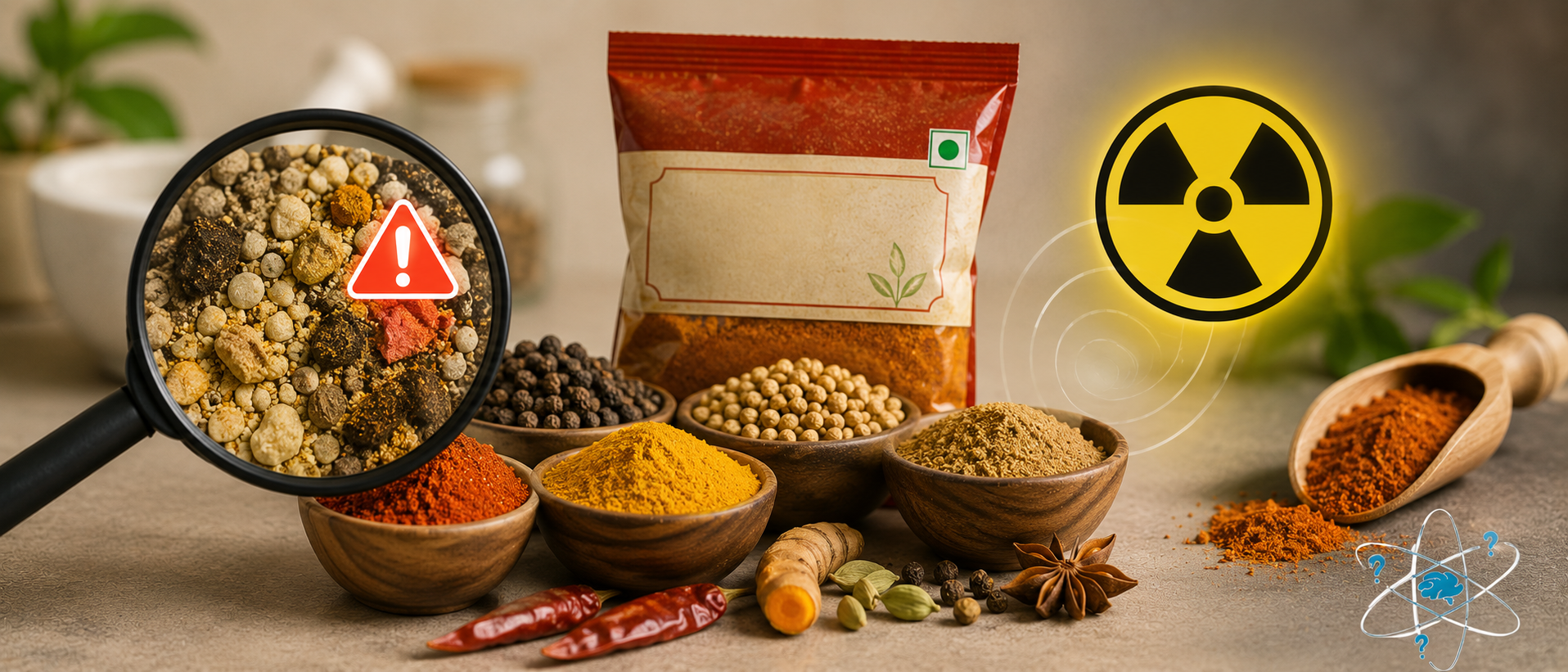
MDH and Everest were recalled in 2024 over ethylene oxide. Lead in turmeric, Sudan dye in chilli — here's how to spot adulterated spices.
The 2024 MDH-Everest Controversy: What Happened
In April 2024, the Hong Kong Centre for Food Safety ordered the recall of three MDH spice blends and one Everest product sold in Hong Kong due to detection of ethylene oxide (EtO) residues exceeding permitted levels. Within days, Singapore's Singapore Food Agency (SFA) issued a similar order recalling Everest's Fish Curry Masala. These actions triggered investigations in multiple countries including Nepal, Australia, and the US into the same products, and received enormous media coverage in India — raising serious questions about the safety of India's packaged spice industry.
MDH (Mahashian Di Hatti) and Everest are two of India's largest and most trusted spice brands, with combined revenues exceeding ₹3,000 crore. Their products are exported to dozens of countries, and both brands have been trusted in Indian households for generations. The recall was therefore not just a food safety event but a significant reputational and economic crisis for India's spice industry — which is also one of India's most important agricultural export sectors.
Ethylene Oxide: What It Is and Why It Is Used (and Dangerous)
Ethylene oxide (EtO, C₂H₄O) is a fumigant — a gas used to kill bacteria, moulds, insects, and other microbial contaminants in dried food products including spices, herbs, and dried fruits. It is highly effective as a sterilant — it penetrates through entire bags and bulk containers, killing microorganisms that would otherwise contaminate the product. Historically it was used extensively in the food industry for spice sterilisation because spices (due to their harvesting and drying conditions in tropical climates) frequently carry high bacterial loads, including potentially pathogenic bacteria like Salmonella.
The health concern with ethylene oxide: it is classified as a Group 1 human carcinogen by IARC — meaning there is sufficient evidence of human carcinogenicity. EtO is a mutagen (causes DNA mutations) and can react with DNA to form adducts that initiate cancer. Chronic low-level exposure is associated with increased risk of leukaemia and lymphoma. Even low residue levels in food are a concern because EtO is both genotoxic (can damage DNA at very low doses) and there is no established 'safe' threshold for genotoxic carcinogens under the precautionary principle.
The EU banned ethylene oxide use for food sterilisation in 1991, with maximum residue limits of essentially zero (0.02 mg/kg as an analytical limit of detection). India's FSSAI also prohibits EtO use in food, but enforcement of this prohibition at the farm gate and in domestic processing is less robust than European regulatory systems.
FSSAI's Response to the 2024 Spice Crisis
Following the Hong Kong and Singapore recalls, FSSAI took a series of actions to address the EtO contamination issue in Indian spices:
Mandatory testing order: FSSAI directed testing of 40+ types of Indian spices for EtO residues across all major brands and export batches.
International protocol alignment: FSSAI requested clarification from Hong Kong and Singapore on their analytical methods, as different testing methods can produce different sensitivity results.
Spice Board coordination: FSSAI worked with the Spices Board of India (which regulates spice exports) to review sterilisation practices across the supply chain.
**Guidance on alternatives:** FSSAI issued guidance to the industry on alternative sterilisation methods that are safe and legally compliant
primarily steam sterilisation and irradiation.
Investigative action: FSSAI initiated investigations into the specific processing facilities and supply chains involved in the recalled products.
Importantly, FSSAI's position was that the recalled products were tested against EU regulatory standards (essentially zero tolerance for EtO), while India's own standards do not set a specific EtO maximum residue limit for domestic sales (beyond the general prohibition on use). This regulatory gap between 'prohibited in use' and 'no specific MRL for residues' allowed products with EtO residues to potentially remain in the domestic market even as they were banned from export markets.
Spice Irradiation: India's Legal Alternative to Ethylene Oxide
India permits the use of ionising radiation (gamma irradiation) for spice sterilisation under FSSAI regulations — specifically under the Food Safety and Standards (Food Products Standards and Food Additives) Regulations and the Atomic Energy Regulatory Board (AERB) oversight. Gamma irradiation using Cobalt-60 is an established and WHO-endorsed technology for reducing microbial contamination in spices and dried herbs without the chemical residue concerns of ethylene oxide.
How irradiation works: spices are exposed to gamma rays that damage the DNA of microorganisms (bacteria, moulds, insects) without significantly heating the product, thereby killing pathogens without chemical treatment. The spices themselves do not become radioactive — irradiation and radioactivity are not the same thing. The WHO, FAO, IAEA, and global food safety authorities have assessed irradiated food as safe for human consumption at approved doses. The EU, US, and most developed food systems permit irradiation of spices at specified doses.
FSSAI requires that irradiated foods carry the international Radura logo (a stylised green symbol) and declaration 'Processed by irradiation' on packaging. This labelling allows consumers to identify irradiated spices. Consumer perception of irradiation in India has been mixed — some consumers and advocacy groups have concerns about irradiated food — but from a safety evidence perspective, irradiation is a significantly safer alternative to ethylene oxide fumigation.
Other Common Spice Adulterants in India
Beyond ethylene oxide, Indian packaged spices face a range of adulteration challenges that FSSAI surveillance consistently identifies:
Turmeric: Metanil yellow and lead chromate (artificial yellow dyes) have historically been used to enhance the colour of turmeric powder. FSSAI has taken strong enforcement action on lead chromate in turmeric (it is toxic and carcinogenic), with significant improvements in branded packaged turmeric quality. Loose turmeric from small shops remains higher risk. Red chilli powder: Sudan dyes (I–IV) — industrial azo dyes — have been found in chilli powder, enhancing colour. Sudan dyes are not approved food colours; they are potential carcinogens. FSSAI regularly tests and takes action. Brick dust and salt have also been used as bulk adulterants. Coriander powder: Dung powder, sawdust, and foreign seeds used as bulk adulterants in some unbranded samples. Cardamom: Artificially greened (with malachite green dye, a carcinogen) — some cardamom has been found with illegal dye application to enhance green colour. Fennel seeds (saunf): Artificial colouring with non-food dyes in some samples.
AaharIQ strongly recommends purchasing spices from FSSAI-licensed, branded packaged sources rather than loose/unbranded spices from shops — the quality controls of registered brands are substantially more reliable, even accounting for the 2024 EtO concerns which prompted significant industry-wide quality improvement.
AaharIQ's summary of common spice adulterants identified by FSSAI surveillance:
| Spice | Common Adulterant | Concern |
|---|---|---|
| Turmeric | Metanil yellow, lead chromate | Lead chromate is toxic and carcinogenic |
| Red chilli powder | Sudan dyes (I-IV), brick dust, salt | Sudan dyes are unapproved industrial azo dyes and potential carcinogens |
| Coriander powder | Dung powder, sawdust, foreign seeds | Bulk adulteration found in some unbranded samples |
| Cardamom | Malachite green dye | A carcinogen used to enhance green colour |
| Fennel seeds (saunf) | Artificial colouring with non-food dyes | Non-food dye use found in some samples |
How to Buy Clean Spices in India: AaharIQ Recommendations
**Always buy FSSAI-licensed branded packaged spices:** MDH, Everest, Catch, Eastern, Suhana, Badshah
despite the 2024 controversy, these brands have quality systems that provide substantially better protection than unbranded loose spice from markets. Post-2024, all major brands have strengthened their EtO testing and sterilisation procedures.
Look for irradiated products (Radura logo): Irradiated spices are safer from a microbial perspective than chemically fumigated equivalents. The irradiation logo should be visible on pack.
Check colour: Unusually vivid, bright red chilli powder or intensely yellow turmeric may indicate artificial colour enhancement. Genuine spice colours are somewhat variable and muted compared to artificially coloured products.
Buy whole spices and grind at home where practical: Whole spices (whole peppercorns, whole cardamom, whole coriander) are significantly harder to adulterate than powders. A small home grinder (mixer-grinder) can produce fresher, more flavourful, and potentially cleaner spice powders than commercial pre-ground versions.
Scan with AaharIQ: AaharIQ checks spice products for FSSAI licence validity, known adulteration red flags for specific spice categories, and Radura irradiation labelling.
References
- [1]IARC (2012). Ethylene oxide — IARC Monographs Vol 100F. IARC Monographs on the Evaluation of Carcinogenic Risks to Humans.
- [2]FSSAI (2024). FSSAI response to recalls of Indian spice brands — MDH and Everest investigations. FSSAI Press Release.
- [3]WHO/FAO/IAEA (1999). High-dose irradiation: wholesomeness of food irradiated with doses above 10 kGy. WHO Technical Report Series 890.
Frequently Asked Questions
FSSAI domestic tests post-recall found no detectable ethylene oxide in sampled branded spices. The Spices Board tightened export testing from May 2024. For domestic sale, major branded spices (MDH, Everest, Catch, Eastern) are currently cleared, but adulteration risks (lead in turmeric, Sudan dye in chilli) remain in loose and unbranded spices.
Without AaharIQ — you're scanning labels with your naked eye, missing hidden additives, E-numbers, and FSSAI violations that could silently harm your health over time.
🔍 Scan your food to check for adulterants in packaged spices instantly
India's free AI food scanner. Detect harmful additives, FSSAI violations & allergens in any packaged food. Get a BUY or AVOID verdict in seconds.
Free tools related to this article
Author
Tags
Related Articles
 🌿
🌿Ashwagandha Leaf Ban: FSSAI's 2026 Advisory Explained
 🧪
🧪BPA in Packaged Food: FSSAI's 2025 Ban & What to Avoid
 🧈
🧈Is Amul Butter and Ghee Safe? Ingredients, Adulteration Tests & Health Check India 2026
Is Maggi Safe to Eat? Full Ingredient Analysis by Nutritionists
 📊
📊