We use strictly necessary cookies to run AaharIQ, and optional functional/analytics cookies to improve it. You can accept all, reject non-essential ones, or . See our Cookie Policy for details.

Titanium Dioxide (E171): Banned in EU, Still in India
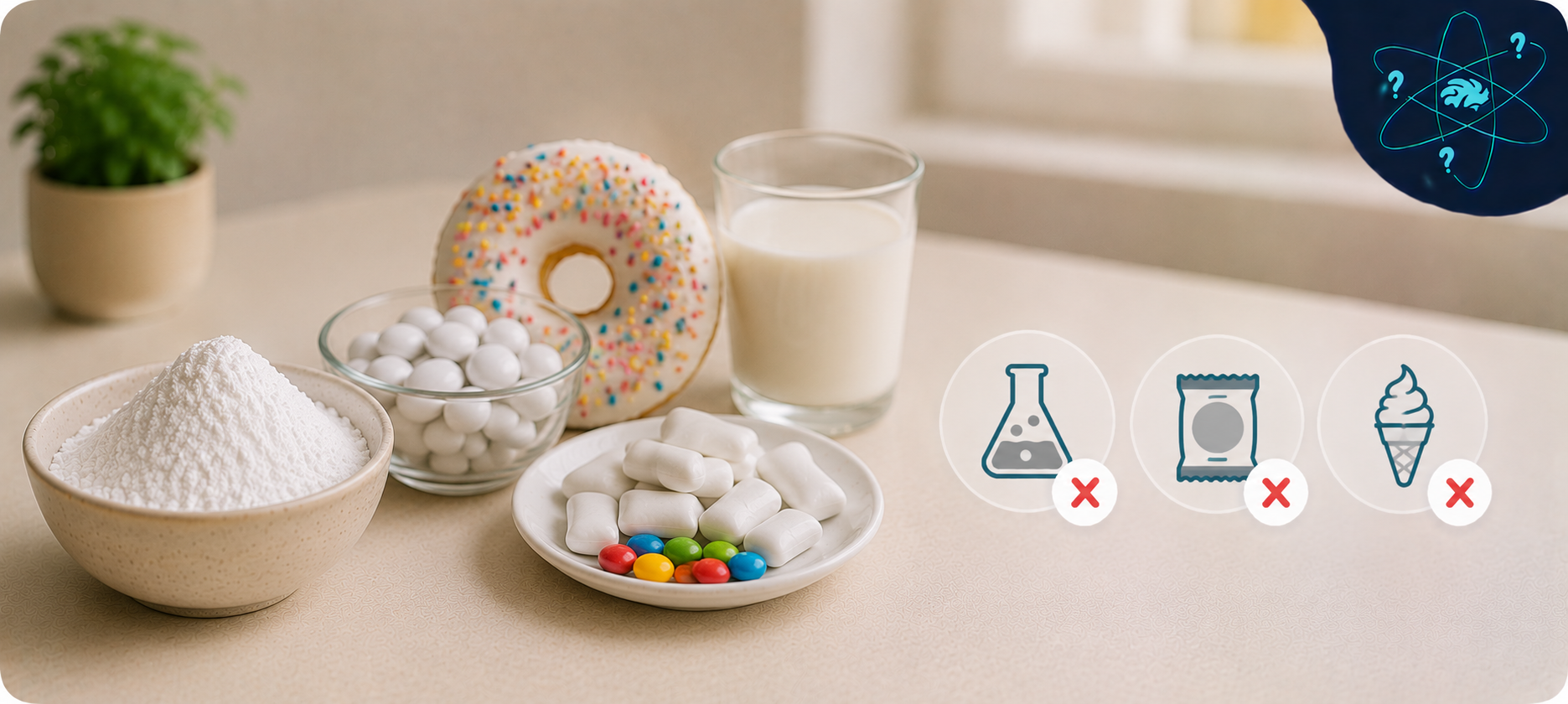
The EU banned titanium dioxide (E171) in food in 2022 over genotoxicity concerns. It's still used in India's candies and bakery products.
What Is Titanium Dioxide and Why Is It in Food?
Titanium dioxide (TiO₂), approved as food additive E171 in the EU and INS 171 under FSSAI regulations in India, is an inorganic white pigment used extensively in food products to provide a bright white colour or opacity. It appears in a wide range of foods: white chewing gum coatings, white icing on cakes and pastries, white salad dressings, cream-filled biscuits, powdered sugar coatings, white candy shells (like those on Gems), marshmallows, white chocolate coatings, and some pharmaceutical capsules.
TiO₂ is also widely used in paints, sunscreens, and cosmetics — applications where its bright white opacity and UV-blocking properties are valuable. Its use in food is primarily cosmetic — it makes products appear whiter and more visually appealing. There is no nutritional benefit from titanium dioxide.
The particle size of TiO₂ used in food matters significantly from a safety perspective. Food-grade TiO₂ (E171) contains a mixture of nano-scale particles (below 100nm) and larger particles. The proportion of nanoparticles varies by manufacturer and batch, but EFSA's 2021 review found that food-grade E171 consistently contains a fraction of nanoparticles — and it is these nanoparticles that carry the genotoxicity concern.
The EU Ban: What EFSA Found That Changed the Regulatory Picture
In May 2021, the European Food Safety Authority (EFSA) published a comprehensive re-evaluation of titanium dioxide as a food additive. The conclusion was landmark: EFSA could no longer conclude that E171 was safe as a food additive. Specifically, EFSA stated that a concern for genotoxicity could not be ruled out — meaning that TiO₂ nanoparticles may be capable of damaging DNA.
Genotoxicity is a particularly serious safety concern because DNA damage can initiate cancer. When a regulatory body cannot rule out genotoxicity, the precautionary principle demands action — particularly when the substance provides no health benefit (being purely cosmetic). EFSA also noted concerns about accumulation of TiO₂ nanoparticles in tissues, particularly in the colon, and potential effects on the immune system.
Based on EFSA's opinion, the European Commission adopted Regulation (EU) 2022/63 in January 2022, withdrawing authorisation for E171 as a food additive. Following a 6-month transition period, the ban became effective in August 2022. Products containing E171 could no longer be sold within the EU from that date. France had already banned E171 nationally in 2020, ahead of the EU-wide decision.
The implications of the EU ban are significant: the same food products sold in India that use E171 (white chewing gum, candy-coated chocolates, iced confectionery) cannot be sold in Europe. Indian consumers are not receiving the same regulatory protection as European consumers.
India's Regulatory Position: FSSAI Has No Specific Ban
As of 2026, FSSAI has not issued a specific prohibition on titanium dioxide (INS 171) as a food additive. Under the Food Safety and Standards (Food Products Standards and Food Additives) Regulations, 2011, INS 171 is listed as a permitted food colour in certain food categories. FSSAI's additive regulations broadly follow Codex Alimentarius standards, which at the international level has not yet banned TiO₂ in food — though a JECFA review is ongoing.
The regulatory divergence is significant. In the EU, the precautionary principle led to a ban once EFSA could not establish safety. Other major regulatory bodies — including the FDA (US), FSANZ (Australia/New Zealand), the UK FSA, and WHO/JECFA — reviewed the same evidence and maintained that current evidence was insufficient to warrant a ban, pointing to limitations in the genotoxicity studies (many were in vitro or animal studies at doses much higher than typical human exposure).
FSSAI has not published a specific opinion on E171 safety in response to the EU ban. This regulatory silence leaves Indian consumers in a situation where they may be consuming TiO₂-containing products without awareness that the same products are prohibited in Europe.
The products most likely to contain TiO₂ in India: Chewing gum (including Wrigley's Orbit, Happydent White), white-coated confectionery, certain cake icings and fondants, white salad dressings, and some pharmaceutical products. Checking ingredient lists for 'INS 171' or 'Colour (INS 171)' or 'Titanium Dioxide' is the most direct way for consumers to identify and avoid these products.
Here is how major regulators have responded to titanium dioxide (E171/INS 171) safety concerns:
| Regulator | Position on E171 | Status |
|---|---|---|
| EFSA (EU) | Could not rule out genotoxicity from the nanoparticle fraction | Banned in food since August 2022 |
| France | Acted ahead of the EU-wide decision | Banned nationally since 2020 |
| FDA (US) | Evidence considered insufficient to warrant a ban | Permitted |
| FSANZ (Australia/NZ) | Evidence considered insufficient to warrant a ban | Permitted |
| UK FSA | Evidence considered insufficient to warrant a ban | Permitted |
| WHO/JECFA | Review ongoing | Permitted, under review |
| FSSAI (India) | No specific opinion issued in response to the EU ban | Permitted, no ban |
The Nanoparticle Question: Why Size Matters in Food Safety
The safety of titanium dioxide in food cannot be evaluated without understanding nanotoxicology — the study of how nanoparticles interact with biological systems differently than their larger-particle counterparts. Nanoparticles (particles below 100nm in at least one dimension) can cross biological barriers that larger particles cannot: they can penetrate cell membranes, cross the gut epithelial lining, enter the bloodstream, and accumulate in organs including the liver, spleen, and colon.
Food-grade TiO₂ (E171) has been shown in multiple studies to contain between 17% and 36% nanoparticles by particle count, depending on the source. Once ingested, these nanoparticles reach the intestinal lining, where they can interact with gut epithelial cells, immune cells, and the microbiome. Animal studies have shown that chronic TiO₂ nanoparticle exposure promotes intestinal inflammation and increases the formation of aberrant crypt foci — an early marker of colon cancer risk.
Human epidemiological data on TiO₂ nanoparticle food exposure and cancer risk are limited — this is part of why regulatory bodies outside the EU maintain that current evidence is insufficient for a ban. However, epidemiological absence of evidence is not the same as evidence of absence. The EU's decision to apply the precautionary principle — removing a substance with no health benefit when safety cannot be confirmed — reflects a legitimate public health approach, particularly for a substance with no nutritional value.
Which Indian Products Contain Titanium Dioxide: A Consumer Guide
AaharIQ's research identified several categories of Indian packaged foods and brands that commonly use titanium dioxide (INS 171). Note that formulations change, and consumers should always check current labels:
Chewing gum: Wrigley's Orbit and Happydent White are among the most prominent — white-coated chewing gum products classically use TiO₂ for their bright white coating. Candy and confectionery: White-shelled chocolate products (like the white variant of Gems and similar sugar-panned chocolates), white fondant icing, and certain white-coloured hard candies. Bakery products: White cake icing (fondant), white chocolate decorations, and some cream-filled biscuits. Dairy and desserts: Some industrial ice cream coatings use TiO₂ for a bright white appearance. Instant noodles: Some noodle masala packets contain white starchy powders where TiO₂ may be used. Pharmaceuticals: Tablet coatings widely use TiO₂ — beyond FSSAI's food jurisdiction but worth noting for total exposure assessment.
The AaharIQ scanner app checks ingredient lists for INS 171 and Titanium Dioxide, flagging its presence and the EU regulatory status. For parents specifically, AaharIQ recommends minimising children's exposure to TiO₂-containing confectionery while regulatory clarity in India develops.
Alternatives to Titanium Dioxide in Food: What the Industry Is Moving Toward
Following the EU ban, food manufacturers globally have been working to reformulate products that used E171. The food industry has identified several viable alternatives for achieving white colour without TiO₂:
Calcium carbonate (INS 170): A natural white mineral widely used as a calcium supplement and food additive. It provides opacity but is less optically white than TiO₂. Used in white chocolate and bakery products. Starch-based opacifiers: White starch coatings can provide opacity in certain applications. Bamboo chalk: Being tested in some chewing gum applications. Calcium phosphate (INS 341): Another naturally occurring white mineral. Modified microcrystalline cellulose: Provides texture and some whiteness. The challenge is that none of these alternatives matches TiO₂'s exceptional opacity and brightness — which is why TiO₂ became so dominant in the first place. Some manufacturers are accepting slightly less brilliant whiteness in reformulated products; others have discontinued white-coated variants entirely.
The EU ban has accelerated innovation in food colouring alternatives globally. India, even without a current ban, should anticipate that multinational companies operating in both EU and Indian markets will eventually harmonise formulations towards TiO₂-free products — as occurred previously with trans fats and certain artificial colours.
AaharIQ Verdict: How Indian Consumers Should Respond to the E171 Issue
The EU's ban on titanium dioxide in food is grounded in legitimate safety science — specifically, the inability to rule out genotoxicity from nanoparticle fractions. India's lack of a corresponding ban reflects regulatory lag, not evidence that TiO₂ is safe. Until FSSAI acts on this issue, Indian consumers are advised to take a precautionary approach. AaharIQ recommendations:
Check labels: Look for 'INS 171', 'Titanium Dioxide', or 'Colour (171)' in ingredient lists.
Prioritise avoidance for children: Children have higher body-weight-relative exposure from confectionery and chewing gum. Given the uncertainty around TiO₂ nanoparticle safety, avoiding these products for young children is prudent.
Use AaharIQ scanner: Scan chewing gum, white-coated candy, and biscuits before purchase to check for TiO₂.
Choose alternatives: When available, choose products that explicitly state 'no artificial colours' or 'E171-free' on their labelling.
Advocate for policy: India's food safety standards should align with EU standards on non-nutritive food additives with safety questions.
Contact FSSAI through consumer channels to advocate for a review of INS 171 in food.
References
- [1]EFSA ANS Panel (2021). Safety assessment of titanium dioxide (E171) as a food additive. EFSA Journal.
- [2]European Commission (2022). Regulation (EU) 2022/63: withdrawal of authorisation for titanium dioxide as a food additive. Official Journal of the European Union.
- [3]Bettini S et al. (2017). Diet-related colonization of TiO2 nanoparticles in rat intestines: colon acting as accumulation site. Nanotoxicology.
- [4]PubMed (2024). Safety of titanium dioxide (E171) as a food additive for humans — review. PMC/NCBI.
Frequently Asked Questions
The EU banned E171 in food in 2022 after EFSA concluded its genotoxicity (DNA damage potential) could not be ruled out. The FDA, UK FSA, and FSSAI maintain it is safe at current levels. The precautionary principle applies: since E171 has no health benefit, avoiding it is prudent.
Without AaharIQ — you're scanning labels with your naked eye, missing hidden additives, E-numbers, and FSSAI violations that could silently harm your health over time.
🔍 Scan your food to check for titanium dioxide food India instantly
India's free AI food scanner. Detect harmful additives, FSSAI violations & allergens in any packaged food. Get a BUY or AVOID verdict in seconds.
Free tools related to this article
Author
Tags
Related Articles
Is Parle-G Safe? Nutritional Analysis of India's Best-Selling Biscuit
 ⚡
⚡Are Energy Drinks Safe? Red Bull, Monster & Sting Reviewed
 ◈
◈How Your Medical Documents Power Smarter, Personalised Health Decisions
 ✧
✧The Future of Precision Health: AI, Genomics, and Nutrition Converging
 💧
💧