We use strictly necessary cookies to run AaharIQ, and optional functional/analytics cookies to improve it. You can accept all, reject non-essential ones, or . See our Cookie Policy for details.

Microplastics in Indian Packaged Food: FSSAI Guide 2026
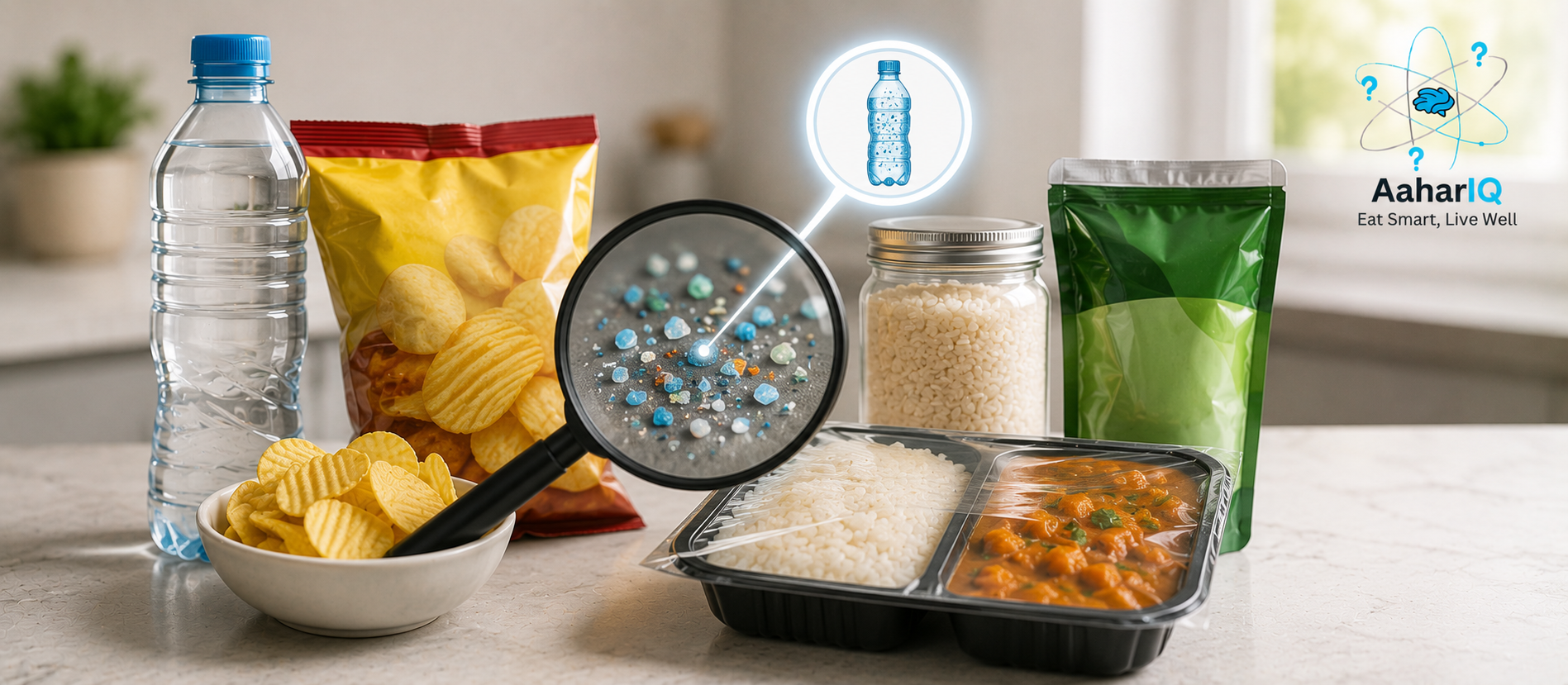
Microplastics turn up in Indian salt, sugar, bottled water, and packaged food, and a 2024 NEJM study links them to 4.5x higher cardiovascular risk.
The Plastic in Your Food: How Microplastics Get Into Indian Packaged Products
Microplastics are plastic particles smaller than 5mm in at least one dimension. Nanoplastics are even smaller — below 1 micrometre. Together, they have become ubiquitous environmental contaminants, found in the deepest ocean trenches, Arctic ice cores, Antarctic snow, and now in the food we eat. They enter food through multiple pathways: from the environment (plastic pollution in soil and water enters crops and seafood), from food processing and packaging (plastic equipment, plastic packaging that sheds particles into food), and from airborne contamination (plastic particles settle on food during storage and preparation).
In India, the plastic contamination problem is compounded by high levels of environmental plastic pollution. India is among the world's largest generators of plastic waste, with significant quantities entering waterways, soils, and ultimately the food chain. A 2024 study in Chennai's surface water found PFAS and microplastic contamination, indicating that aquatic food sources in Indian rivers and coastal waters carry microplastic contamination risks.
The Indian packaged food industry uses plastic extensively — for primary packaging (pouches, trays, bottles), secondary packaging (shrink wrap, crates), and in food processing equipment. While food-grade plastics are designed to minimise leaching, no plastic is entirely inert, particularly under conditions of heat, UV exposure, mechanical stress, or prolonged contact with acidic or oily foods. The question is not whether microplastics are present in Indian packaged food but how much and what health effects they carry.
Toxics Link 2024 Report: Microplastics Found in Indian Salt and Sugar
In August 2024, the environmental organisation Toxics Link published a significant study revealing the presence of microplastics in Indian salt and sugar samples. The study examined 10 salt samples (including rock salt, sea salt, iodised salt, and organic/local varieties) and 5 sugar samples (including white refined sugar, raw sugar, and organic sugar) from various Indian brands.
Key findings: Microplastics were detected in all salt samples tested. The concentration ranged from approximately 4 to 12 particles per 100g across different salt brands. International studies have found similarly widespread microplastic contamination in sea salt globally — a reflection of plastic pollution in ocean environments from which sea salt is derived. Rock salt from underground mineral sources showed lower contamination than sea salt varieties.
For sugar samples, microplastics were detected in some samples, at lower concentrations than in salt. The contamination in sugar is thought to arise primarily from processing equipment and packaging rather than the raw agricultural source. White refined sugar goes through multiple processing stages involving plastic and metal equipment, each stage offering potential for microplastic introduction.
The Toxics Link findings mirror global research: a 2020 study in Environmental Research found microplastics in 90% of tested salt samples from 16 countries. A 2024 CNN-reported study found that food packaging sheds microplastics into food content. The Indian Toxics Link study contextualises this global problem within the specific Indian market, providing evidence that Indian consumers face the same microplastic exposure pathways as consumers globally.
FSSAI's Response: The March 2024 Microplastics Research Initiative
In March 2024, the Food Safety and Standards Authority of India launched a formal research initiative titled 'Micro- and Nano-Plastics as Emerging Food Contaminants: Establishing Validated Methodologies and Understanding the Prevalence in Different Food Matrices.' This programme aims to develop and validate standardised analytical methods for detecting microplastics and nanoplastics in Indian food products and to assess their prevalence across different food categories.
This is a significant step. India has not previously had standardised regulatory testing methods for microplastics in food. The FSSAI initiative will establish baseline data on microplastic contamination across food categories in India — data that is necessary for evidence-based regulatory action. The programme is expected to run across multiple years, with results informing whether and what regulations should be set for maximum microplastic levels in food.
The EU is also developing regulatory standards for microplastics in food and drinking water, and WHO published a preliminary risk assessment of microplastics in drinking water in 2019 (updated guidance ongoing). The global regulatory landscape for microplastics is evolving rapidly — from being an environmental concern with no food safety standards to an active regulatory priority. India's FSSAI initiative positions it to act once the research base matures.
Health Effects of Microplastics: What the Science Says
The health effects of microplastic ingestion are an active area of research, with the field evolving rapidly as detection methods improve and longer-term studies accumulate. Current evidence indicates several areas of concern:
Cardiovascular risk: A landmark study published in the New England Journal of Medicine (March 2024) found that people with microplastics and nanoplastics embedded in their carotid artery tissue were significantly more likely to experience a myocardial infarction (heart attack), stroke, or death from any cause over the following 3 years, compared to people without such particles. This human prospective study is the strongest direct evidence to date of microplastic-associated cardiovascular harm in humans.
Inflammation: Microplastics are recognised to trigger inflammatory responses in gut tissue. Animal studies show that chronic microplastic ingestion promotes intestinal inflammation, disrupts the gut mucosal barrier, and alters gut microbiome composition — all of which are risk factors for inflammatory bowel disease, metabolic syndrome, and colorectal cancer.
Endocrine disruption: Some plastic additives (plasticisers like phthalates and bisphenols) that are associated with microplastic particles are known endocrine disruptors, interfering with oestrogen, testosterone, and thyroid hormone signalling. These effects are particularly concerning during pregnancy and early childhood development.
Exposure estimate for India: Researchers estimate that urban Indians may ingest approximately 5–7 grams of microplastics annually — roughly the mass of a credit card — through food, water, and airborne inhalation combined. This is consistent with global estimates, though Indian exposure may be higher due to greater environmental plastic contamination.
High-Risk Indian Foods and Products for Microplastic Exposure
Based on available research and the routes of microplastic contamination in food systems, AaharIQ identifies the following as higher-risk categories for microplastic exposure in the Indian context:
Packaged water in plastic bottles: Studies globally have found microplastics in packaged water, with plastic bottles being a significant source. Mechanical stress during transit and temperature fluctuations (PET bottles exposed to heat in delivery trucks or direct sunlight) increase particle shedding. Indian consumers who rely heavily on packaged water are at higher exposure risk. Sea salt and salt from coastal sources: As documented by Toxics Link, Indian salt brands — particularly sea salt — contain microplastics from ocean pollution. Seafood: Shellfish (mussels, oysters) and small fish consumed whole accumulate microplastics from marine environments. Seafood consumption from highly polluted coastal regions (many parts of India's coastline near industrial zones) carries higher risk. Tea bags: Plastic-mesh tea bags (nylon or polypropylene) shed billions of microparticles when steeped in hot water. Studies have found that a single plastic tea bag at 95°C releases approximately 11.6 billion microplastics and 3.1 billion nanoplastics. Indian consumers who use plastic mesh tea bags should switch to paper or loose-leaf tea. Food microwaved in plastic containers: Heating food in polypropylene containers significantly increases plastic particle migration into food compared to room-temperature storage.
AaharIQ's summary of the higher-risk microplastic exposure categories identified for Indian consumers:
| Source | Why It's Higher Risk |
|---|---|
| Packaged water in plastic bottles | Mechanical stress and heat during transit increase particle shedding from PET bottles |
| Sea salt and salt from coastal sources | Toxics Link (2024) found 4-12 microplastic particles per 100g across Indian salt samples |
| Seafood (shellfish, small fish) | Accumulate microplastics from polluted coastal waters |
| Plastic mesh tea bags | A single bag at 95 degrees C releases about 11.6 billion microplastics and 3.1 billion nanoplastics |
| Food microwaved in plastic containers | Heating polypropylene containers significantly increases plastic particle migration into food |
AaharIQ's Microplastic Reduction Guide for Indian Consumers
Complete elimination of microplastic exposure is not currently possible — the contamination is too widespread in the global food system. However, meaningful reduction is achievable through practical steps that AaharIQ recommends:
Switch from plastic bottled water to filtered tap water: Install a reverse osmosis or ultrafiltration system and use a stainless steel or glass water bottle. This eliminates one of the most significant microplastic exposure routes.
Use paper tea bags or loose-leaf tea: Replace plastic mesh tea bags with paper tea bags or a stainless steel tea strainer. This one change eliminates billions of microparticles per cup of tea.
Heat food in glass, ceramic, or stainless steel: Never microwave food in plastic containers. Use glass or ceramic containers for microwave heating.
Choose glass, paper, or metal packaging over plastic where available: Glass jar preserves, metal tin canned products, and paper-based packaging generally introduce fewer microplastics than plastic packaging.
Prefer rock salt over sea salt: Rock salt (sendha namak) from underground mineral deposits has lower microplastic contamination than sea salt.
Wash fresh produce thoroughly: Surface microplastics on fruits and vegetables can be reduced through thorough washing under running water.
Reduce plastic waste: Participating in India's plastic waste management (proper segregation, reduced single-use plastics) ultimately reduces environmental contamination that enters the food chain.
References
- [1]Toxics Link (2024). Microplastics in Indian salt and sugar brands. Toxics Link India.
- [2]Marfella R et al. (2024). Microplastics and Nanoplastics in Atheromas and Cardiovascular Events. New England Journal of Medicine.
- [3]FSSAI (2024). Research initiative on microplastics and nanoplastics as emerging food contaminants. FSSAI Annual Report.
- [4]Nor NH M et al. (2021). Lifetime accumulation of microplastic in children and adults. Environmental Science and Technology.
Frequently Asked Questions
Yes. Studies have detected microplastics in Indian branded salt, sugar, bottled water, and packaged seafood. Plastic packaging, industrial equipment, and environmental contamination of raw materials are primary sources. FSSAI is conducting research but has not issued specific limits.
Without AaharIQ — you're scanning labels with your naked eye, missing hidden additives, E-numbers, and FSSAI violations that could silently harm your health over time.
🔍 Scan your food to check for microplastics instantly
India's free AI food scanner. Detect harmful additives, FSSAI violations & allergens in any packaged food. Get a BUY or AVOID verdict in seconds.
Free tools related to this article
Author
Tags
Related Articles
 📋
📋There's No Official FSSAI Banned List — Here's the Real One
 ⚡
⚡Are Energy Drinks Safe? Red Bull, Monster & Sting Reviewed
 🏷️
🏷️"Multigrain", "Natural", "No Added Sugar" — Misleading Health Claims on Indian Packaged Food
 🧪
🧪BPA in Packaged Food: FSSAI's 2025 Ban & What to Avoid
 ◈
◈