We use strictly necessary cookies to run AaharIQ, and optional functional/analytics cookies to improve it. You can accept all, reject non-essential ones, or . See our Cookie Policy for details.

FSSAI vs EU vs FDA: Where India Is Stricter, and Where It Isn't

India permits 8 synthetic food colours; the EU permits far more. India banned potassium bromate in 2016; the US still hasn't. A corrected, evidence-based comparison of FSSAI, EU and FDA food standards.
The short answer: it cuts both ways
The popular framing — that FSSAI is simply a weaker regulator than the EU or the FDA — does not survive contact with the actual rulebooks. On some measures India is genuinely stricter than both. On others it lags badly. Treating it as a single "safety gap" gets the picture wrong in both directions.
| Area | Who is stricter | The short version |
|---|---|---|
| Synthetic food colours | India | India permits 8 synthetic colours. The EU permits far more, including Quinoline Yellow and Allura Red, which are not on India's permitted list. |
| Potassium bromate | India and EU | India banned it in June 2016. The EU banned it in 1990. The US still permits it federally. |
| Trans fats | Tie (India/EU) | Both cap industrially produced trans fat at 2% of total fat. |
| Titanium dioxide (E171) | EU | Banned outright in the EU since August 2022. India still permits it in specific categories, including chewing gum at up to 1%. |
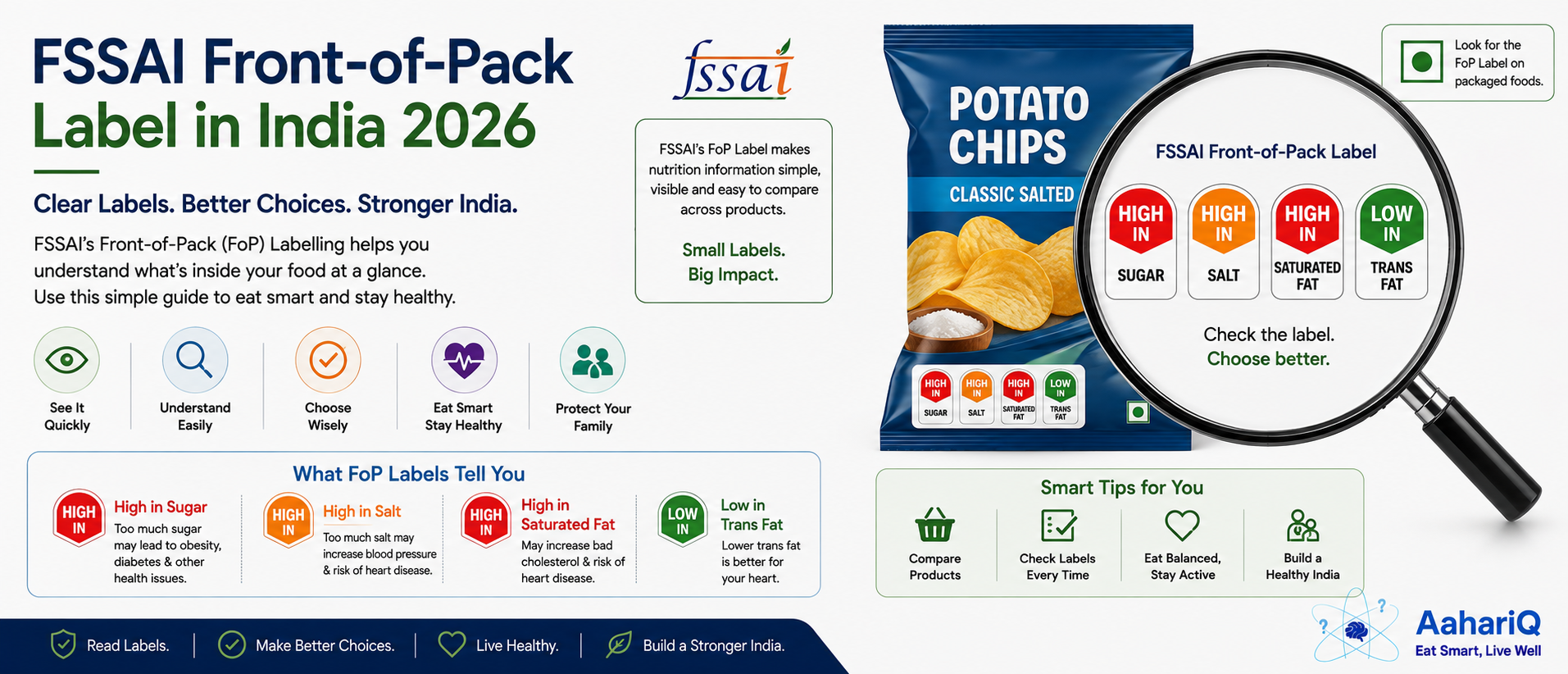
| Front-of-pack warning labels | EU and Latin America | India has none in force. A "red hexagon" proposal is before the Supreme Court right now. |
| Pesticide residues (export reality) | EU | EU RASFF flagged 527 India-linked food items for ethylene oxide between Sept 2020 and April 2024. |
| Added sugar in baby food | EU | Nestlé sold Cerelac with ~3 g added sugar per serving in India and zero added sugar in Switzerland, Germany and the UK. |
The honest summary: India's permitted additive list is in several respects narrower than the EU's and clearly narrower than the FDA's. Where India falls behind is not usually the list of what's allowed — it's consumer-facing disclosure (no front-of-pack warning), enforcement reach across a vast informal supply chain, and residue control in agricultural commodities.
This article goes through each claim with the current rule, the date it changed, and the source.
Where India is stricter than the EU and the US
This is the part most comparisons skip entirely, and it is the part that most often surprises people.
Synthetic colours. FSSAI permits exactly eight synthetic food colours: Tartrazine (INS 102), Sunset Yellow FCF (INS 110), Carmoisine (INS 122), Ponceau 4R (INS 124), Erythrosine (INS 127), Indigo Carmine (INS 132), Brilliant Blue FCF (INS 133) and Fast Green FCF (INS 143). That is a short list by world standards.
The so-called "Southampton Six" — the colours linked in the 2007 University of Southampton study to hyperactivity in children, which must carry a warning label in the EU — are Tartrazine (E102), Quinoline Yellow (E104), Sunset Yellow (E110), Carmoisine (E122), Ponceau 4R (E124) and Allura Red (E129).
| Southampton Six colour | Permitted in the EU | Permitted in India |
|---|---|---|
| Tartrazine (E102 / INS 102) | Yes, with warning label | Yes |
| Quinoline Yellow (E104) | Yes, with warning label | No — not on India's permitted list |
| Sunset Yellow (E110 / INS 110) | Yes, with warning label | Yes |
| Carmoisine (E122 / INS 122) | Yes, with warning label | Yes |
| Ponceau 4R (E124 / INS 124) | Yes, with warning label | Yes |
| Allura Red (E129) | Yes, with warning label | No — not on India's permitted list |
So India permits four of the six, and simply does not allow the other two in food at all. The EU permits all six but requires the hyperactivity warning. Which regime is "stricter" depends entirely on whether you value prohibition or disclosure — but "India permits the Southampton Six without restriction" is not a correct statement, and an earlier version of this article said exactly that. It has been corrected.
Potassium bromate. FSSAI removed potassium bromate from the list of permitted food additives on 20 June 2016, following the Centre for Science and Environment's May 2016 bread study, which found residues of potassium bromate and/or potassium iodate in bread sold in Delhi. The EU banned it in 1990. The United States has never banned it federally — it remains permitted in bread there, though California has moved against it at state level.
On this specific, well-known IARC Group 2B carcinogen, India acted a decade ago and the US still hasn't. Note one real caveat: CSE also asked FSSAI to ban potassium iodate, and that did not happen in the 2016 action. The All India Bread Manufacturers' Association voluntarily pledged to drop both.
Trans fats. India caps industrially produced trans fatty acids at 2% of total fat (fully in force from 2022), matching the EU's 2% limit (2021). The US took a different route — revoking the GRAS status of partially hydrogenated oils rather than setting a percentage cap — and permits a "0 g trans fat" label for anything under 0.5 g per serving, which allows small amounts to go undeclared.
Where India genuinely lags
Now the other side of the ledger, where the criticism is fair.
| Gap | Status in India | Status in EU / US |
|---|---|---|
| Front-of-pack warning labels | None in force. Indian Nutrition Rating (star system) notified 2022, no stakeholder consensus. Red hexagon proposal pending before the Supreme Court. | Nutri-Score widely used across EU member states; mandatory warning octagons in Chile, Mexico, Israel, Peru |
| Hyperactivity warning on colours | Not required | Mandatory in the EU for the Southampton Six |
| Titanium dioxide (E171) | Permitted in specific categories, including chewing gum up to 1% (10,000 mg/kg) | Banned outright in the EU since 7 August 2022 |
| Acrylamide in fried/baked foods | No enforceable limit | EU benchmark levels; US guidance levels |
| Pesticide residue control on exports | 527 India-linked items flagged by EU RASFF, Sept 2020 – April 2024 | EU default MRL applies automatically where no specific limit is set |
| Added sugar in infant cereals | Permitted; Cerelac sold with ~3 g added sugar per serving | Zero added sugar in Nestlé's Swiss, German and UK Cerelac lines |
The pattern here is worth naming precisely. With the exception of titanium dioxide, most of these are not gaps in what India permits — they are gaps in what Indian consumers are told, and in what gets caught. A product can be fully FSSAI-compliant and still carry information the shopper never sees.
Potassium bromate: India banned it in 2016, the US still hasn’t
This deserves its own section because it is the single most commonly repeated error about Indian food regulation, and an earlier version of this article repeated it too.
In May 2016, the Centre for Science and Environment published a study finding residues of potassium bromate and/or potassium iodate in 84% of the bread and bakery samples it tested in Delhi. Potassium bromate is classified by IARC as Group 2B — possibly carcinogenic to humans.
FSSAI's response was fast by any regulator's standards. On 20 June 2016, when the operationalised standards for food additives took effect, potassium bromate was dropped from the permitted-additives list. Cyclamates were removed in the same action. Using potassium bromate in food in India has been illegal since that date.
| Jurisdiction | Potassium bromate status | Since |
|---|---|---|
| European Union | Banned | 1990 |
| Canada, UK, Brazil, Sri Lanka, Nigeria, China | Banned | Various |
| India | Banned | 20 June 2016 |
| United States | Still permitted federally | — |
If you read anywhere — including in the earlier version of this page — that Indian bakers may still legally use potassium bromate, that is out of date by about a decade. What remains true is that potassium iodate was not banned alongside it, despite CSE explicitly requesting that, and excess iodine intake carries its own thyroid-related concerns.
Titanium dioxide (E171): the real status in India
Titanium dioxide, listed as E171 in Europe and INS 171 in India, is a whitening and opacifying agent with no nutritional function. It is used to make confectionery, chewing gum, coatings and some sauces look brighter and whiter.
The European Food Safety Authority concluded in 2021 that E171 could no longer be considered safe as a food additive, specifically because a concern for genotoxicity — the potential to damage genetic material — could not be ruled out, and therefore no safe daily intake level could be established. The EU ban took effect after a six-month phase-out, with full prohibition from 7 August 2022.
India has not followed. But the precise status matters, and the earlier version of this page overstated it by implying blanket permission. FSSAI permits titanium dioxide in specific food categories at specified limits, not across the board — notably in chewing gum and bubble gum at up to 1% (10,000 mg/kg), and in powdered concentrate mixes for fruit drinks at up to 100 mg/kg.
So the accurate statement is: a chewing gum reformulated to remove E171 for the European market can still legally contain it in its Indian formulation, made by the same manufacturer. That is a real and specific divergence. It is not the same as saying titanium dioxide is freely permitted throughout Indian packaged food.
This is the clearest single case where the EU is straightforwardly stricter than India on a permitted additive, and where the underlying scientific evidence available to both regulators is identical.
Red Dye No. 3: banned in the US in 2025, permitted in India as erythrosine
In January 2025, the US FDA revoked the authorisation for FD&C Red No. 3 in food and ingested drugs. Manufacturers using it in food have until January 2027 to reformulate.
The history is what makes this one striking: Red No. 3 was banned from cosmetics and externally applied drugs back in 1990, after studies found it caused thyroid tumours in male rats. Its use in food and oral medication nonetheless continued for a further 35 years, until petitions from consumer advocacy groups finally forced the inconsistency closed.
The same dye is erythrosine, INS 127 — and it is one of India's eight permitted synthetic colours, used in candies, jellies and flavoured syrups. India has issued no comparable restriction.
This is a genuine gap, and an unusually clean one: the underlying animal evidence dates to the 1980s, it is not contested, and it was sufficient for a US ban in one product category 36 years ago. Checking ingredient lists for erythrosine or INS 127 by name is the direct individual safeguard available today.
Ethylene oxide: MDH, Everest and 527 EU alerts
The largest real-world test of how Indian food standards compare internationally is not a rulebook comparison at all — it is what happens when Indian food reaches foreign borders.
Ethylene oxide is a fumigant used to sterilise spices and dried goods. It is classified by IARC as a Group 1 carcinogen — the highest category, meaning carcinogenic to humans. The EU banned it as a pesticide in 2011.
The April 2024 spice recalls:
| Date | Regulator | Action |
|---|---|---|
| 5 April 2024 | Hong Kong Centre for Food Safety | Flagged ethylene oxide in MDH Madras Curry Powder, MDH Sambhar Masala, MDH Mixed Masala Powder and Everest Fish Curry Masala |
| April 2024 | Singapore Food Agency | Ordered recall of Everest Fish Curry Masala (50 g) |
| 22 April 2024 | FSSAI | Launched nationwide inspection drive of spice manufacturers |
| Late April 2024 | Maldives, Nepal | Implemented their own bans |
| April 2024 | US FDA, Australia, Bangladesh | Opened investigations / began reviewing |
The EU picture is larger than the spice story. Between September 2020 and April 2024, the EU's Rapid Alert System for Food and Feed (RASFF) flagged 527 India-linked products for ethylene oxide contamination — 525 food and 2 feed products. India was recorded as the sole country of origin for 332 of them. Eighty-seven consignments were rejected at the border. The largest affected categories were nuts and sesame seeds (313) and herbs and spices (60), with dietetic foods (48) also significant. Fifty-four of the flagged items were labelled organic.
Reporting since indicates EU member states rejected a further 365 Indian food products between May 2024 and May 2026 over pesticide residues and heavy metals.
There is a mitigating fact that is usually left out: India's Spices Board made ethylene oxide testing mandatory for all spice consignments bound for the EU from 2022, and EtO-related EU alerts on Indian commodities fell substantially afterwards. The 2024 Hong Kong and Singapore actions concerned markets outside that mandatory-testing regime.
What FSSAI’s own testing found — and why both results may be true
FSSAI's own testing produced a result that sits awkwardly against the international findings, and honest reporting has to include it.
Following the April 2024 recalls, FSSAI collected 34 samples — 9 from Everest facilities in Maharashtra and Gujarat, and 25 from MDH facilities in Delhi, Haryana and Rajasthan. By 21 May 2024, 28 laboratory reports had returned, and ethylene oxide was not detected in any of them. Six results were still pending at that point. MDH publicly stated the allegations were untrue and lacked evidence.
How can both things be true? Several explanations are plausible and none has been conclusively established publicly:
What this episode genuinely demonstrates is narrower than either side claimed at the time: it shows that Indian and foreign testing regimes can reach different conclusions about the same brands, which is itself the substantive regulatory gap. A consumer cannot resolve that from a label.
Nestlé Cerelac: the documented double standard
The clearest documented case of a company applying different standards to Indian consumers came in April 2024, from the Swiss investigative NGO Public Eye, working with the International Baby Food Action Network.
Their investigation found that Nestlé sold Cerelac infant cereals in India containing roughly 3 g of added sugar per serving, while the equivalent products in Switzerland — where Nestlé is headquartered — as well as Germany and the United Kingdom, contained zero added sugar.
The WHO advises against added sugar in foods for infants and young children, citing links to childhood obesity and later chronic disease. Nothing in FSSAI's rules prohibited what Nestlé did in India; the products were compliant.
Nestlé India subsequently announced it would reduce added sugar in its infant cereal portfolio by up to 30%. In November 2025, Public Eye returned with similar findings covering markets across Africa, Asia and Latin America, indicating the practice was not confined to India and had not been fully resolved.
This case is the strongest argument in the whole debate, because it isolates the variable. Same company, same brand, same product category — different formulation, driven by what each market's regulator requires and what each market's consumers are equipped to notice.
Front-of-pack labelling: the red hexagon now before the Supreme Court
This is the most consequential gap, it is unresolved, and it is live in court this week.
India has no front-of-pack warning label in force. The Indian Nutrition Rating, a star-based system, was notified in draft in 2022; FSSAI's own expert committee recorded that there was no stakeholder consensus on it. It never became mandatory.
The matter is now being driven by litigation rather than by the regulator. The case is a public interest litigation brought by the NGO 3S and Our Health Society against the Union of India.
| Date | Development |
|---|---|
| 2022 | Indian Nutrition Rating (star rating) notified in draft; no stakeholder consensus |
| 9 April 2025 | Supreme Court disposes of the original PIL, directing FSSAI to act |
| February 2025 | Draft Food Safety and Standards (Labelling and Display) Amendment Regulations, 2025 notified — proposes nutrition information in bold type |
| 24 November 2025 | FSSAI's 49th Food Authority meeting defers the matter |
| 15 February 2026 | Supreme Court says the exercise "has not yielded any positive or good result"; grants four weeks for a fresh response |
| 28 August 2026 | FSSAI affidavit proposes interpretive labels flagging fat, sugar and salt via a pictorial "red hexagon" |
| 10 September 2026 | Court frames a detailed set of questions on phased rollout, nutrient thresholds, design and placement; seeks affidavits within 10 days |
| 28 September 2026 | Next hearing |
The Court's questions are notably specific. Among them: the justification for the Phase I versus Phase II split, the scientific basis for the nutrient thresholds, whether a red hexagon risks being confused with India's red dot non-vegetarian mark, how to prevent manufacturers from reformulating with artificial additives to dodge a threshold, and whether nutritional literacy should be taught in schools.
If this lands, it will be the single largest change to Indian food labelling in a generation — and it will have come from a courtroom, not from FSSAI's own rulemaking.
Pesticide residue limits: the least visible gap
Maximum residue limits — the legally permitted quantity of a pesticide remaining on food at point of sale — are where the gap is most real and least visible to a shopper, because residue is not something you can read off a label.
The EU's structural advantage is its default limit: where no specific, scientifically justified MRL has been established for a pesticide-crop combination, a very low default applies automatically. The burden sits with the applicant to justify anything higher. India's framework sets limits for specific pesticide-crop combinations, and where a combination is not covered the position is less automatically protective.
The EU RASFF record described above is the practical evidence of what that difference produces at the border.
Enforcement capacity compounds it. India's agricultural supply chain is vast, fragmented and substantially informal, and testing infrastructure for fresh produce does not reach most of it. The EU's more consolidated supply chain is far easier to sample.
For an individual, this is the hardest gap to act on, since nothing on the pack discloses residue. The practical mitigations are limited but real: wash fresh produce thoroughly — a diluted vinegar or salt-water soak held for a few minutes measurably outperforms a quick rinse in reducing surface residue — peel where practical, and where budget and availability allow, prefer certified organic for the produce categories most associated with high residue load.
Why the gap persists: capacity and disclosure, not indifference
It would be lazy to frame this as India simply caring less about food safety. The structural picture is more specific, and it explains the shape of the gaps rather than just their existence.
FSSAI is young and was built while running. It was established under the Food Safety and Standards Act, 2006, and spent its first decade consolidating a patchwork of older laws. EFSA has a large, continuously funded scientific review apparatus whose job is to re-evaluate existing approvals against new evidence — the titanium dioxide ban came out of exactly that routine re-evaluation process, not a scandal.
The supply chain is a different problem entirely.** The EU regulates a comparatively consolidated food industry. FSSAI regulates that *plus* millions of small and informal vendors. A rule that is straightforward to enforce in a Hamburg supermarket chain is a genuinely hard problem across Indian retail. This is why India's permitted-additive list can be narrow while outcomes remain uneven: **the list is not the binding constraint, enforcement reach is.
Disclosure is politically harder than prohibition. Removing an additive affects a handful of manufacturers. A front-of-pack warning label affects every packaged product on the shelf and every brand's marketing. That is precisely the fight now playing out in the Supreme Court, and it is why India banned potassium bromate in 2016 within weeks of a study, but has spent four years unable to agree on a label.
None of this excuses the specific gaps. It does explain why they close incrementally, and why the ones that persist longest are the ones that require telling consumers something rather than telling manufacturers something.
What this actually means when you’re shopping
Stripping out the regulatory theory, here is what actually changes your shopping:
1. India's colour list is short — use that. Only eight synthetic colours are permitted. If you see a colour name or INS number on an Indian pack, it is one of those eight. Erythrosine (INS 127) is the one now banned from food in the US. Tartrazine (102), Sunset Yellow (110), Carmoisine (122) and Ponceau 4R (124) are the four that carry a mandatory hyperactivity warning in the EU and no warning here.
2. Potassium bromate is not a live concern in Indian bread. It has been illegal since June 2016. Potassium iodate was not included in that ban.
3. Check chewing gum for titanium dioxide / INS 171. This is the clearest category where Indian formulations can legally contain something removed from EU formulations.
4. Imported-brand products may differ from their home-market versions. The Cerelac case is documented. The general lesson holds: a global brand's Indian formulation is set by Indian rules, not by its home market's.
5. Nothing on a label tells you about pesticide residue. Wash produce properly; it is the only lever you have.
6. Read the nutrition panel, because nothing on the front will warn you. Until the red hexagon case concludes, there is no front-of-pack signal for high sugar, salt or fat in India. That work falls entirely on you.
How AaharIQ Helps
AaharIQ evaluates products against the stricter of the FSSAI, EU or FDA position for any given ingredient — not FSSAI compliance alone. Where a product is legal in India but would require a warning label or be prohibited in another major market, it is flagged, with the specific rule and jurisdiction named.
In practice that means surfacing: the four Southampton colours that carry a mandatory hyperactivity warning in the EU and none here; titanium dioxide (INS 171) in categories where India still permits it; erythrosine (INS 127), now revoked for food use in the US; BHA and BHT; and nitrate/nitrite preservatives with their IARC classification attached.
The point is not that Indian rules are uniformly worse — as this article documents, on several additives they are tighter than the FDA's. The point is that the information exists, the divergences are documented, and there is no reason a shopper in India should have to reconstruct it from regulatory filings at the shelf.
FAQs
Is FSSAI weaker than the FDA or the EU?
Not uniformly, and the blanket claim is wrong. India permits only eight synthetic food colours, a shorter list than the EU's, and excludes Quinoline Yellow and Allura Red entirely. India banned potassium bromate in 2016; the US still permits it federally. Where India genuinely lags is consumer disclosure — there is no front-of-pack warning label — along with enforcement reach across an informal supply chain, and pesticide residue control on agricultural exports.
Is potassium bromate still allowed in Indian bread?
No. FSSAI removed it from the permitted-additives list on 20 June 2016, following the Centre for Science and Environment's bread study. It has been illegal for a decade. Potassium iodate, which CSE also asked to be banned, was not included in that action.
Is titanium dioxide banned in India?
No. The EU banned E171 outright from 7 August 2022 after EFSA could not rule out genotoxicity. India still permits INS 171 in specific categories at specified limits, including chewing gum and bubble gum at up to 1%, and powdered fruit-drink concentrates at up to 100 mg/kg. It is not permitted across all foods.
Why were MDH and Everest spices banned in Hong Kong and Singapore?
In April 2024, Hong Kong's Centre for Food Safety flagged ethylene oxide — an IARC Group 1 carcinogen — in three MDH products and Everest Fish Curry Masala, and Singapore ordered a recall of Everest Fish Curry Masala. Maldives and Nepal followed with their own restrictions. FSSAI then tested 34 samples from both companies' facilities and reported that 28 returned lab results showed no ethylene oxide.
How many Indian food products has the EU rejected?
Between September 2020 and April 2024, the EU's RASFF system flagged 527 India-linked products for ethylene oxide, with India the sole country of origin for 332 of them and 87 consignments rejected at the border. The largest categories were nuts and sesame seeds (313) and herbs and spices (60). Reporting indicates a further 365 Indian food products were rejected by EU member states between May 2024 and May 2026 over pesticide residues and heavy metals.
Does India have front-of-pack warning labels?
Not yet. The Indian Nutrition Rating star system was notified in draft in 2022 but never made mandatory, with no stakeholder consensus. In August 2026 FSSAI proposed a pictorial "red hexagon" warning for fat, sugar and salt in an affidavit to the Supreme Court, which is hearing a PIL brought by 3S and Our Health Society. The next hearing is 28 September 2026.
Which artificial colours require a warning label in the EU but not in India?
Four of the Southampton Six are permitted in India: Tartrazine (INS 102), Sunset Yellow (INS 110), Carmoisine (INS 122) and Ponceau 4R (INS 124). All four carry the mandatory EU warning "may have an adverse effect on activity and attention in children." No such warning is required in India. The other two Southampton colours, Quinoline Yellow and Allura Red, are not permitted in India at all.
Did Nestlé really add sugar to Indian baby food but not European?
Yes, and it is documented. Public Eye's April 2024 investigation found Cerelac infant cereals sold in India with roughly 3 g of added sugar per serving, while Nestlé's Swiss, German and UK Cerelac products carried zero added sugar. Nestlé India then announced a reduction of up to 30%. Public Eye reported similar findings across Africa, Asia and Latin America in November 2025.
Is Red Dye No. 3 banned in India?
No. The US FDA revoked its authorisation for food and ingested drugs in January 2025, with a reformulation deadline of January 2027. The same dye is erythrosine, INS 127, and it remains one of India's eight permitted synthetic colours.
Is Indian packaged food unsafe?
Not categorically. Most FSSAI-compliant products are safe for healthy adults at normal serving sizes, and on several specific additives India's rules are tighter than the FDA's. The legitimate concerns are narrower: products that are legal here but would require a warning elsewhere, the absence of any front-of-pack signal for high sugar, salt and fat, and chronic cumulative exposure that no single product label captures.
Sources, method and corrections
Regulatory actions and primary reporting FSSAI removal of potassium bromate from permitted additives, 20 June 2016 — Centre for Science and Environment; FoodNavigator CSE bread study, May 2016 — Centre for Science and Environment EFSA scientific opinion on titanium dioxide (E171), 2021, and EU prohibition effective 7 August 2022 — Food Safety Authority of Ireland; USDA FAS US FDA revocation of FD&C Red No. 3 authorisation, January 2025 FSSAI permitted synthetic food colour list (8 colours) Titanium dioxide permitted limits in India, including chewing gum at 1% Ethylene oxide and the 2024 spice recalls Hong Kong Centre for Food Safety and Singapore Food Agency actions, April 2024 — Business Today; The Week; Business & Human Rights Resource Centre EU RASFF data, September 2020 – April 2024: 527 India-linked alerts — Business Standard; Deccan Herald; Business & Human Rights Resource Centre FSSAI sampling and lab results, 34 samples / 28 reports, May 2024 — The Week; Business Today; Deccan Herald Spices Board mandatory EtO testing for EU-bound consignments from 2022 Infant food Public Eye / IBFAN investigation into Nestlé Cerelac added sugar, April 2024; follow-up November 2025 Front-of-pack labelling litigation 3S and Our Health Society v. Union of India — LiveLaw (15 February 2026 hearing); India Legal (10 September 2026 hearing, 28 August 2026 FSSAI affidavit, red hexagon proposal, next hearing 28 September 2026) Draft Food Safety and Standards (Labelling and Display) Amendment Regulations, 2025, notified February 2025; deferred at the 49th Food Authority meeting, 24 November 2025 Indian Nutrition Rating, notified in draft 2022 Corrections to the earlier version of this page. Three claims in the previous version were wrong and have been fixed:
it stated potassium bromate was "still permitted (under review)" in India
it has been banned since 20 June 2016;
it stated the Southampton Six colours were "permitted without restriction" in India
two of the six, Quinoline Yellow and Allura Red, are not permitted in India at all, and the other four are subject to quantitative limits;
it implied titanium dioxide was broadly permitted in Indian food
it is permitted only in specified categories at specified limits.
Last updated: 24 September 2026. The front-of-pack labelling case is active, with the next hearing listed for 28 September 2026; this section will date quickly.
Frequently Asked Questions
Not uniformly. India permits only eight synthetic food colours — a shorter list than the EU's — and excludes Quinoline Yellow and Allura Red entirely. India banned potassium bromate in 2016; the US still permits it federally. Where India genuinely lags is consumer disclosure (no front-of-pack warning label), enforcement reach across an informal supply chain, and pesticide residue control on exports.
Without AaharIQ — you're scanning labels with your naked eye, missing hidden additives, E-numbers, and FSSAI violations that could silently harm your health over time.
🔍 Scan your food to check for fssai vs eu fda standards instantly
India's free AI food scanner. Detect harmful additives, FSSAI violations & allergens in any packaged food. Get a BUY or AVOID verdict in seconds.
Free tools related to this article
Author
Tags
Related Articles
 👶
👶Packaged Food Marketed to Children India: The Hidden Harmful Ingredients Parents Must Know
 ✧
✧The Future of Precision Health: AI, Genomics, and Nutrition Converging
 🦋
🦋Thyroid Patients: Which Packaged Foods to Avoid?
 🥨
🥨Is Haldiram's Safe to Eat? Ingredients, Preservatives & Health Check India 2026
 📋
📋